


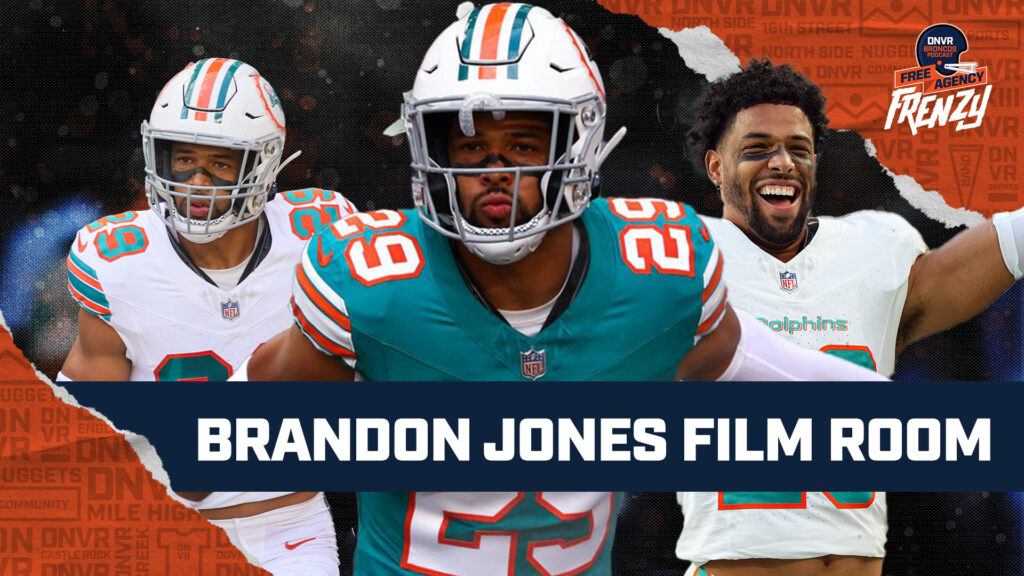
The Denver Broncos signed safety Brandon Jones, 25, on Monday to a three-year deal worth $20 million, with $12.5 million guaranteed. He can earn another $2.5 million if he hits all of his incentives.
The move comes a few days after the Broncos released four-time All-pro safety Justin Simmons to save $14.5 million in salary cap space. Simmons was the longest-tenured Bronco, joining the team as a third-round draft pick in 2016.
On Sunday, the Broncos re-signed safety PJ Locke, 27, who started eight games in 2023, the first eight starts of his career.
Caden Sterns, 24, a fifth-round pick in 2021, JL Skinner, 22, a sixth-round pick last season, and Delarrin Turner-Yell, 24, a fifth-round pick in 2022, round out the Broncos likely safety rotation.
Jones, 25, was a fifth-round draft pick of the Miami Dolphins in 2020. He played collegiately at Texas where he was a teammate of Sterns and Locke. All three played for the 2018 Longhorns.
Jones started for the Dolphins in 2021 and 2022, but his 2022 campaign was cut short by a torn ACL. He returned in 2023, but served as the third safety behind DeShon Elliott and Jevon Holland. He started six regular-season games because of injuries to the two starters. He also started the Dolphins’ Wild Card loss to the Chiefs because of Holland’s injury.
We’re going to dig into the tape from that game.
(The clips seem to load better on Chrome. If they’re struggling to load, try refreshing.)
Brandon Jones vs. Travis Kelce
We’re starting with the fun stuff.
Brandon Jones lined up in man coverage against Travis Kelce often in this game.
On this red zone play, Jones communicates a switch in assignments because of Kansas City’s motion. Then he erases Kelce’s drag route.
(Jones is No. 29, and he’s wearing long white sleeves. Remember this.)
This time, Miami is blitzing. A linebacker lines up across from Kelce. But the linebacker crashes into the backfield, leaving Jones in man coverage behind him.
The Chiefs realize what is happening and Kelce curls up underneath before Jones can get to him.
In Vic Fangio’s defense, disguise is everything. The Dolphins want their defense to look as similar as possible on every play. That’s why Jones didn’t take away the space between himself and Kelce before the snap.
Later on, the Dolphins show a two-high safety look, their typical starting point. Just before the snap, Jones creeps forward to eliminate Kelce’s space so Mahomes can’t rip a ball to him. Jones funnels Kelce toward his help, the linebacker playing a zone in the middle of the field.
Later on, Jones takes up man coverage against Kelce near the end zone. He’s patient, keeping his heels on the goal line, and waits for Kelce to make his break. Jones smothers him. It’s teach tape.
In the final clip, Jones fights through traffic to smother Kelce one more time.
More Man Coverage
This time, Jones has wide receiver Rashee Rice (the inside man in the bunch) on a corner route. Easy work.
A few plays later, he covers another wide receiver, Marquez Valdes-Scantling, on a drag route out of a bunch (Valdes-Scantling is the inner-most receiver). Once again, it’s easy work.
In the final clip, Jones may have gotten away with a hold. Mecole Hardman certainly thinks so. Regardless, it’s impressive that Miami’s coaching staff trusts Jones to handle one of the league’s fastest receivers one-on-one with no help over the top.
Jones was essentially flawless in man coverage in this game. It’s tough to find anything to complain about. He’s capable of handling tight ends in the slot. He held up well against receivers, too.
Deep Zone Coverage
Jones is generally considered a box safety, but I’m not convinced that he shouldn’t play deep.
Compared to the rest of the league, Vic Fangio doesn’t play much Cover 3, which would place Jones as a center fielder. Here’s the only example I saw in the game.
Jones sets up deep and takes away the post cleanly.
While there isn’t much Cover 3, there’s plenty of Cover 4 and Cover 6. We’re going to start with some of the Cover 6 tape.
In Cover 6, the deep portion of the field is split in half. On one side, the defense plays Cover 4. That’s one safety deep and a corner dropping deep up the sideline. Each player has a quarter of the field. The other half of the field is the responsibility of the other safety.
In this clip, Jones is responsible for a “quarter.” He sees the post and has plenty of speed to run with the receiver across the deep middle of the field. (Jones is the deepest player at the snap.)
This time, Jones aligns on the “half” side. Nobody on his half of the field runs deep, so he picks up the deep route crossing from the other side of the field. Once again, there’s never a window. (Jones is the safety closer to the bottom of the screen at the snap.)
Jones has the same half-field assignment for this play. The difference is that a receiver on his side of the field runs deep. The cornerback’s job is to re-route the receiver inside to give Jones leverage. He does just that. Then Jones picks him up and carries him deep. (Jones is the safety closer to the bottom of the screen at the snap.)
Now let’s get into some Cover 4.
Cover 4 is a simpler coverage. The outside cornerbacks drop and take away the deep boundaries. The safeties are each responsible for the area inside the cornerbacks on their side of the field. Essentially, the deep portion of the field is split into quarters, with each player taking one of the portions.
On this play, Jones waits for the receiver to cross into his zone, then carries him. It’s a simple play, with textbook footwork once again. (Jones is the safety toward the top of the screen.)
This is the same call. But this time, the receiver breaks back outside. Jones runs with him and blankets him again. (Jones is the safety closer to the top of the screen.)
I left the game with zero complaints about Jones in zone coverage. He was in the right spot on every play. He erased deep routes. He did exactly what he was told.
The Broncos, at least in some ways, run a similar system. Both Denver and Miami disguise coverages often. Neither runs much Cover 2, which can be a safety-intensive coverage.
But the Fangio system is unique. In passing situations, they run more Cover 6 than any other team in the league, and that’s where Jones impressed me most. Of all the teams in the league, Denver is probably among the five or ten easiest transitions for Jones, but it’s still a transition.
Blitzing
Brian Flores was Miami’s defensive coordinator when Jones broke out. Flores blitzes more than any other defensive coordinator in the NFL, so Jones had plenty of opportunities to try his hand, and he’s developed into one of the league’s most electric blitzers from the safety position.
But before we get to the highlights, we’re going to hit the downside: when an offensive lineman gets a hand on Jones, he rarely fights past him to make the play.
It isn’t a big deal. Lineman are stronger than safeties. And in the run play above, Jones maintained gap integrity despite not getting into the backfield cleanly.
But it’s important to remember that Jones doesn’t automatically notch a sack or tackle for loss every time he blitzes. He isn’t a cheat code.
However, Jones had five sacks in his second NFL season while leading all of the league’s defensive backs in quarterback pressures. Blitzing is what Jones is known for.
This is edge-rusher-like bend to get by the guard. (Ignore that the quarterback got the ball out quickly so it didn’t matter.)
This time he rushes the other side and gets a hit on Patrick Mahomes.
And another…
These are the plays he’s known for…
The Running Game
As noted above, Jones isn’t elite at getting off of blocks. Linemen put him just about wherever they want.
This time a tight end locks him up in space near the bottom of the screen.
In the next clip, Jones’ responsibility is to force the running back inside. He can’t quite make the tackle, but he fulfills that baseline duty.
Brian Dawkins or John Lynch might have made that tackle, but that isn’t Jones’ game.
Jones isn’t useless in the run game. He just isn’t a plus run defender. He still makes some plays, but not at a special rate.
As a safety, Jones will primarily provide run support from the back end of the defense. He’s more than capable of filling this role.
In one-on-one situations, Jones can get the running back onto the ground. He probably won’t knock him backward, though.
Jones has missed 14.3% of his NFL tackle attempts, according to PFF. That’s a typical number for a safety. For perspective, last year Ja’Quan McMillian missed 17.7% of his tackles, Alex Singleton missed 14.1%, PJ Locke missed 14% and Justin Simmons missed 11.8%.
Final Thoughts
Brandon Jones is a good player.
He’s a versatile safety who can line up in man or zone coverage and win. He locked up tight ends. He ran with receivers. That’s a great starting point.
In deep zone coverage, Jones was a step ahead of the offense. He was always in the right spot. He knew his job. He communicated well, too.
Jones’ downside in coverage is that he doesn’t have elite physical tools. At 6-foot-1 and about 200 pounds, Jones is pretty typical for a safety. He isn’t the lanky athlete that Justin Simmons is, and that probably plays a big part in why he only has three career interceptions. At 6-foot-3, Simmons has the length to make more plays on the ball, and that’s part of the reason why he leads the NFL in interceptions since entering the league.
Jones, in my opinion, is unlikely to be a major playmaker in coverage. That’s fine. Plenty of safeties aren’t playmakers in the passing game. Kareem Jackson never picked off more than two passes in a season with the Broncos, but he was still a valuable piece of Denver’s coverage unit.
I’m confident that Jones can be an important piece for the Broncos. He’s smart. He reads plays well. He’s athletic enough. He won’t get picked on. I don’t think he’ll be targeted much at all. He’s a plug-and-play cover guy.
By PFF’s counting, Jones was in coverage for 234 snaps from Week 12 onward. He didn’t give up a touchdown. He picked off two passes. He allowed a 29.8 passer rating when targeted.
Those are, obviously, great numbers. Maybe picking up the second and third interceptions of his career in his past four games is a sign of things to come.
In the run game, Jones can handle his business. He isn’t meant to battle linemen. He probably won’t build a reputation as a hitter. That’s not his game.
Jones is a clean tackler. As the last line of defense, that’s the most important role for a safety.
Plus, Jones will earn enough tackles for loss as a blitzer off the edge to make him feel like a plus run defender in a handful of games each year.
Despite his blitzing ability, I think it would be wasteful to only use Jones as a box defender. Sure, he can rush the edge and battle with tight ends and slot receivers in the passing game, but I think he might be at his best playing deep. He’s polished. He’s trustworthy. And while he might not pick off many passes, I think he can lock down deep routes.
A fair comparison for Jones, based solely on one day of watching him, might be Justin Simmons… but without the length and range that makes Simmons a turnover monster. That’s a major caveat, but it leaves a good, trustworthy player who can handle just about any responsibility thrown his way.
For less than $7 million per year, that’s a good deal.
Click here for our breakdown of new Denver Broncos defensive lineman Malcolm Roach.