


“The rain in Spain stays mainly in the plain.”
– My Fair Lady
Often we’d secretly like to do the very things we discipline ourselves against.
– Claude Rains
“Why do you keep getting in your own way?”
– Rainn Wilson
I have had some rains on my brains today, and I cannot seem to grasp the reins of whether or not they will reigns over my brains. Let me refrains. Phew. Three words that sound exactly alike, usually mean very different things, and have somehow all come together in the Denver Broncos‘ offensive meeting room.
There’s another word that starts with “reign” that I’ve heard once or twice with some big football-shaped news that came out on Thursday. The word is reignited, which is what Broncos fans are desperately hoping Denver can do with an offense that has spent its first four weeks that could use a spark.
But let’s not get ahead of ourselves. We might rain on our own parades.
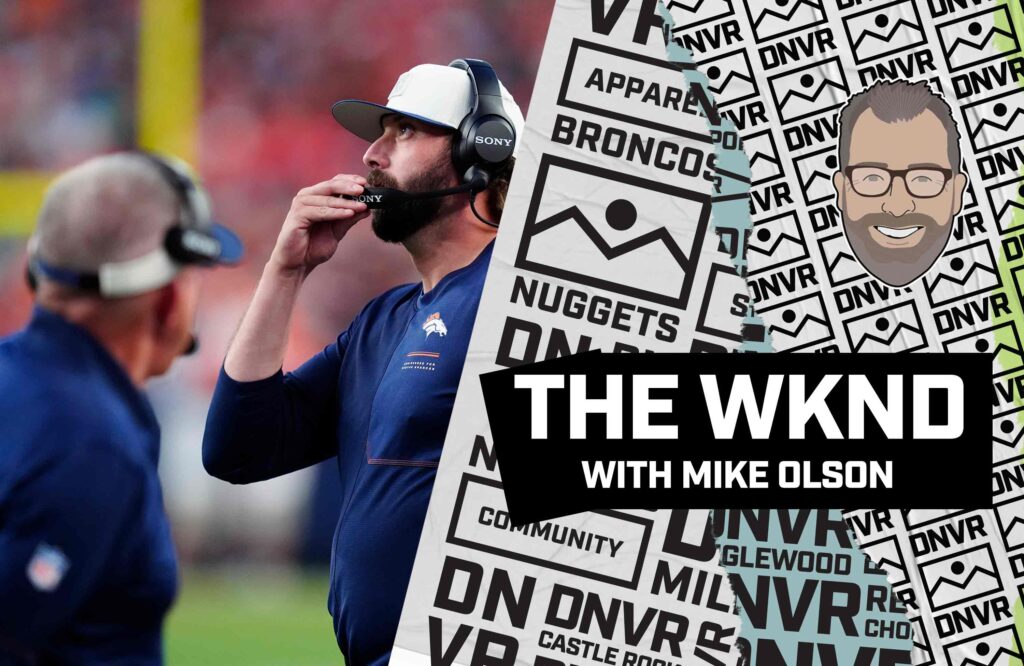
The big news this week is that Payton has taken back the play-calling reins from offensive coordinator Davis Webb after only four games. The Broncos are 2-2, the offense ranks 27th in both scoring and total yards, and the running game is currently 29th in the NFL. The Broncos have scored a whopping 13 first-half points all season.
Thirteen. In four games. That’s barely more than a field goal per half, if you’re keeping score at home. Which, given how the Broncos have played in those halves, you may have stopped doing.
Payton has decided enough is enough. But is this a change that fixes the offense, or a change that simply changes who’s holding the reins?
The Reins
According to our own Zac Stevens, Payton informed Webb and the team of the decision on Monday, several days before publicly announcing it Thursday. He was quick to praise Webb, describing him as a future NFL head coach, and emphasized that the problems were collective rather than the responsibility of any one man. I believe him. He’s been on the other side of this equation in his own career. He knows how this stings.
Webb is a highly regarded young coach, one Denver went out of its way to retain and promote. Payton handed him the play sheet this offseason with the idea that relinquishing those responsibilities would allow the head coach to focus more completely on the rest of the team.
A reasonable idea. Especially when the guy handing over those reins has a Super Bowl ring, a couple decades of offensive wizardry, and a pretty good idea of what it takes to win in this league.
But the early returns have gotten buffeted by some pretty heavy storms. Less rain, more tornado at times.
The Broncos have struggled to run the ball, struggled to sustain drives, and struggled mightily to get anything going before halftime. An offense that was supposed to take another step forward with third-year quarterback Bo Nix has instead taken a couple steps backward. Maybe sideways.
And while Webb was the one calling the plays, it’s worth asking how much of what we’ve watched was actually his doing.
A beautifully designed play can be ruined by a missed block. A perfectly timed route can go unnoticed by a quarterback looking elsewhere. A running back can find a hole that disappears before he gets there. One small breakdown can turn a six-yard gain into a three-yard loss, which turns a manageable second down into a desperate third down, which turns a promising possession into another appearance by the punter. Nix said as much this last week.
And Denver has seen a lot of appearances by the punter.
Football offenses are remarkably complicated machines. Every piece needs to work with the others, and sometimes the smallest adjustment changes the output dramatically. A little better protection buys a little more time, which allows a receiver to get a little farther downfield, which gives the quarterback a little more confidence to make a throw. Suddenly, what looked like a terrible offense looks like a pretty good one.
Or the machine keeps sputtering, and you discover the problem was somewhere else entirely. Is Payton the adjustment? We’re about to find out. Maybe it just gives every other part of the machine notice to clean up their acts as well.
The Reigns
Here’s where I think Payton deserves a little perspective.
This is a Super Bowl-winning head coach who inherited a Broncos franchise that had spent years wandering through the NFL wilderness, then brought it back to relevance in a remarkably short time. He’s earned a hell of a lot more than four games’ worth of benefit of the doubt.
If Sean Payton believes he can improve this offense by calling the plays himself, I’m inclined to give him a very long leash. Or reins.
Sorry. I’m trying.
But Payton never really stopped reigning over this offense in the first place. He was still the head coach, still responsible for the game plan, still ultimately accountable for what happened on Sundays. He delegated play-calling authority, not responsibility for the results.
And the guys actually playing the game have been pretty clear that Webb wasn’t alone in the struggles.
In another great piece from Zac last week, Bo Nix defended his young coordinator after the loss to San Francisco, pointing to the extraordinary quality of the defenses Denver had faced and acknowledging that the players weren’t making Webb’s job particularly easy. Jaylen Waddle echoed those sentiments, putting much of the responsibility on the offense’s execution.
That matters. There’s a difference between a coordinator who has lost the confidence of his players and one whose players believe they’ve let him down. The Broncos sound a lot more like the latter.
And then there’s Nix himself. Bo has become something of the ultimate comeback kid, a quarterback who has been doubted more frequently than the existence of Bigfoot and has spent much of his football life proving people wrong.
Nix is also having a rough start to 2026.
As Zac detailed in his examination of Denver’s conservative passing attack this week, Nix led the league with 37 throws behind the line of scrimmage through four weeks. His average yards per attempt ranked 27th, and against San Francisco, more than half his completions went to running backs.
That’s a lot of horizontal football for a team hoping to move vertically.
But what does it mean? Has Nix reached some sort of ceiling? Is this simply another wall he’ll eventually break through? Has the pressure of heightened expectations caused him to play more cautiously? Or is this just a shitty four-game stretch against some exceptionally good defenses?
I don’t know. And neither, I suspect, does anyone who has already decided exactly what Bo Nix is going to be. John Elway had lousy stretches. Tom Brady had them. Joe Montana, too. Even the greats occasionally looked considerably less than great. Nix hasn’t earned comparison to those careers yet, but he has earned the opportunity to develop without every difficult Sunday becoming a referendum on his future.
Payton taking back the play sheet might help him enormously. The head coach’s experience, instincts, and ability to simplify an offense could put Nix in better situations and restore some confidence. They had remarkable success these first couple seasons together. But Payton can’t throw the football for him.
At least I don’t think he can. With Sean, you get reluctant to rule anything out.
The Rains
Here’s the part of this story that may be getting lost in all the thunder. Denver’s first four opponents were Kansas City, Jacksonville, Los Angeles, and San Francisco. All four ranked among the NFL’s top ten scoring defenses entering this week.
That’s a pretty miserable way to introduce a first-time play-caller to his new job.
The Broncos have faced good defenses, made their own share of mistakes, and struggled to establish the sort of offensive rhythm that can make a coordinator look brilliant. Sometimes, when it rains, it pours. And sometimes you’re standing in a downpour wondering why your matches won’t light.
Now comes the interesting part. The Chargers enter Sunday’s game ranked 24th in scoring defense, allowing 26.5 points per game. On paper, that’s a considerably more forgiving opponent than anything Denver has seen so far. So what happens if the Broncos suddenly score 30 points?
Payton will get the credit. And perhaps he’ll deserve every bit of it.
But some of that improvement might have happened with Webb calling plays, too. We won’t know. Football doesn’t offer the luxury of running the same game twice with different coordinators, holding every other variable constant.
And what happens if the Broncos struggle again? Well, at least the reins will be firmly in Payton’s hands, and there won’t be much mystery about where the questions will be directed. But it may shift where folks are looking for the problems. It’s an interesting gamble, especially for a coach who has earned the latitude to make it.
As alluded to above, there’s also a human element worth remembering. Payton himself had play-calling duties taken away by Giants head coach Jim Fassel in 2002. He knows how that feels. He also knows that four years later he was the head coach of the New Orleans Saints, on his way to becoming one of the most successful offensive minds of his generation.
Webb’s story is hardly over. Neither is Nix’s. And despite the first four weeks, neither is Denver’s season.
The Broncos have enough talent to be considerably better offensively than they’ve shown. Their head coach has an extensive history of making offenses work, and their quarterback has an equally impressive, if much shorter, history of overcoming doubts. There’s reason to believe that a few small adjustments could make this machine hum again. There’s also reason to wonder whether the problems run deeper than the guy choosing the plays.
Was this a necessary leadership decision by a coach who recognized that his offense needed a change? Or did Davis Webb become the convenient casualty of problems that extend well beyond play-calling?
We don’t know. But we’re sure about to find out. Sean Payton has the reins again. He never stopped reigning.
Now we’ll see whether he can make it rain.