


Deciding who is the best of the best in something as multifaceted and challenging as playing the hot corner in MLB is a subjective task. It will lead to various conflicting answers depending on varying perspectives and values.
That’s why trying to boil the entire conversation down to one single number always feels a bit empty. And the recent gap between how the fans and how MLB Network’s number-crunching Shredder see the question reveals an important reminder.
There are lots of things that even the most advanced analytics just completely miss that the smallest amount of logical thinking can correct.
If you are looking primarily at the preferred weighed metrics like WAR (any version) wRC+ and others, Alex Bregman makes perfect sense to top the list.
Of course, any baseball fan who has been both alive and awake for the last few months knows that his statistics, across the board, are now incredibly suspect in the aftermath of a massive sign-stealing scandal.
The “cold hard facts” of his numbers tell one story, but it would be intellectually dishonest to take them at face value and even the most elementary application of basic logic would lead a 10-year-old to that conclusion.
Taking this obvious step led the fans to properly adjust their rankings and ironically proved a great deal more about the process of using only numbers, and literally zero additional human thought, to reach conclusions.
While Bregman’s role in the scandal is an easy thing to recognize and then try to account for, there are several other shortcomings in the blind spot of even our best all-encompassing statistics. We are still in the infancy of measuring defense, for example.
Let’s set aside Nolan Arenado’s seven consecutive Gold Gloves and the ways his defense is immeasurable for now to make this a fair fight.
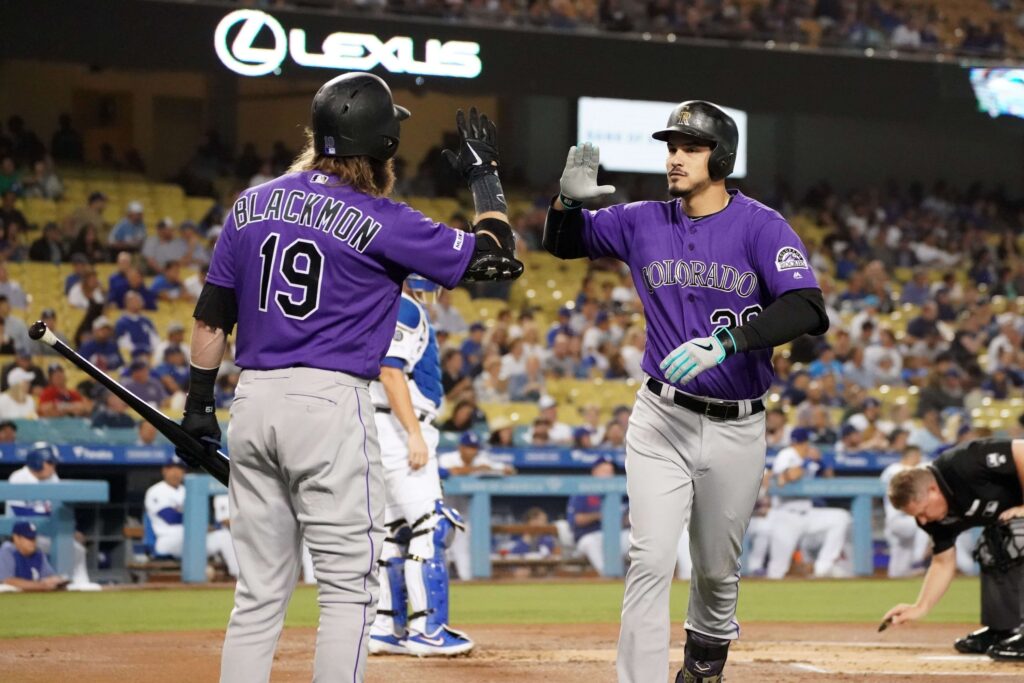
If you’re looking for the biggest reason why Colorado Rockies’ superstar has never once appeared atop any of these lists, despite blazing a trail toward being arguably the greatest third baseman who ever lived, you need look no farther than the word constantly left out of the conversation that has nonetheless defined his career: Clutch.
Yes, the Coors Field factor is messing with his numbers plenty but the biggest omission is not about why or where Arenado gets his run production, but when.
Throughout his career, we have chronicled his insane ability to deliver when it matters the most, noting recently that batting in the “clutch” clearly has more of an impact for Nolan than batting at home or even against left-handed pitching.
So, how do the other candidates stack up? Not bad, but not Nolan.
Over four seasons, Bregman has produced a very solid .975 OPS with runners in scoring position and a .999 OPS with two outs and RISP. In High Leverage situations, he has posted an .834 OPS which is good but lower than what he puts up in Low and Medium Leverage opportunities.
Anthony Rendon is quite similar with a .947 OPS w/RISP, .877 w/RISP and two outs, and a High Leverage mark of .813. Like Bregman, he hits better in Low and Medium Leverage situations.
Arenado? Yeah, he’s still the King.
With RISP, his OPS is 1.042. With two outs, that number actually climbs to 1.066. And in High Leverage situations, his .939 OPS is just a few points shy of his Medium Leverage production and over 100 points higher than his Low Leverage production. It’s also 105 points better than Bregman and 126 more than Rendon.
To make it simple, the stat tOPS+ measures the player against themselves on a scale where 100 is their own average. So a player with a 120 tOPS+ in High Leverage situations is (theoretically) about 20 percent better in the clutch than he is the rest of the time.
Here are the totals:
Arenado: tOPS+ = 109
Rendon: tOPS+ = 90
Bregman: tOPS+ = 85
It’s not only the ballpark that needs to be adjusted for.
There are a couple of conclusions you could reach from this. One could be that Coors Field is worth about 100 points of OPS regardless of the situation. Even when hitting on the road!
Another could be that this is all statistical noise. That while Arenado has been measurably better with the game on the line for seven years running, it might still just be randomness or accident or a mirage that his production is so heavily weighted toward those moments.
Conversely, you could make the argument that Bregman and Rendon are a bit more consistent.
Taking an at-bat down 6-1 in the fourth inning certainly won’t qualify as “High Leverage” but the data suggests the non-Rockies here are more likely to start a rally in that circumstance than Arenado is.
Then comes the question of projecting future value. Stats like WAR and wRC+ are specifically designed to be predictive and would suggest (despite any long-running consistency) that a player who does especially well in the clutch is unlikely to continue to do so.
And that may well be true.
But the facts are clear when it comes to a past that we can measure.
In a hypothetically neutral ballpark against a hypothetically neutral opponent in a hypothetically neutral game situation, Bregman and Rendon might indeed be the better options for a manager to slot in at third base.
In a real ballpark, against a real opponent, with the real game on the line? It’s not even a question.

0 Comments (1 conversation)
ColoradoFanOxford
How many of the “experts” know that Rox players get penalized for hits away from Coors and that visitors don’t get punished for an 11-15 trip to Coors. How is this allowed? How many Rox players have been hurt by this lunacy?
Clutch is a real thing. Some players focus more in key situations, others fade. Its why some relievers with great stuff are never more than 7th inning guys and some guys with lesser stuff can nail down a save. We are humans, which means we cannot bring the same level of intensity and focus to every play. Arenado, who has largely known he has to carry this team (whereas Bregman has the “MVP” in Altuve and Correa), which means when the game is on the line, he can’t fail. If he does, the team does.
Statistical noise fades when you look at 7 years of performance. We know what he we know, up to today, Arenado is the man you want at 3rd not just on defense, but when the game on the line. And I bet if you asked the managers who they want (anonymously), you’d see Nolan’s name down there 9 times out of 10.
Drew Creasman
Author100 percent