© 2026 ALLCITY Network Inc.
All rights reserved.



The NBA’s awards are too difficult, and the league should get worse. It’s too hard parsing this many historically great players amongst each other, deciding which unique skillset and one-of-one athlete does cooler things with the basketball than the other one. It does sometimes feel like each criteria’s flavor changes every season based on our human biases. There, I’ve made my case against awards.
They’re also deeply important to the league’s history, of course, which explains why I’ve spent the past week pouring over this season’s numbers and candidacies even though, unlike in the past, my ballot is but an unofficial one. These decisions are much harder, or at least they were for me, when my selections helped memorialize the players who earned these honors. I don’t miss that, at least, especially seeing how difficult I already found it to write this column.
I’ve already named and argued for the non-MVP, non-team awards, which you can read here. I’ll summarize them with a tool from our ALL NBA Podcast. You should fill out your own ballot here.

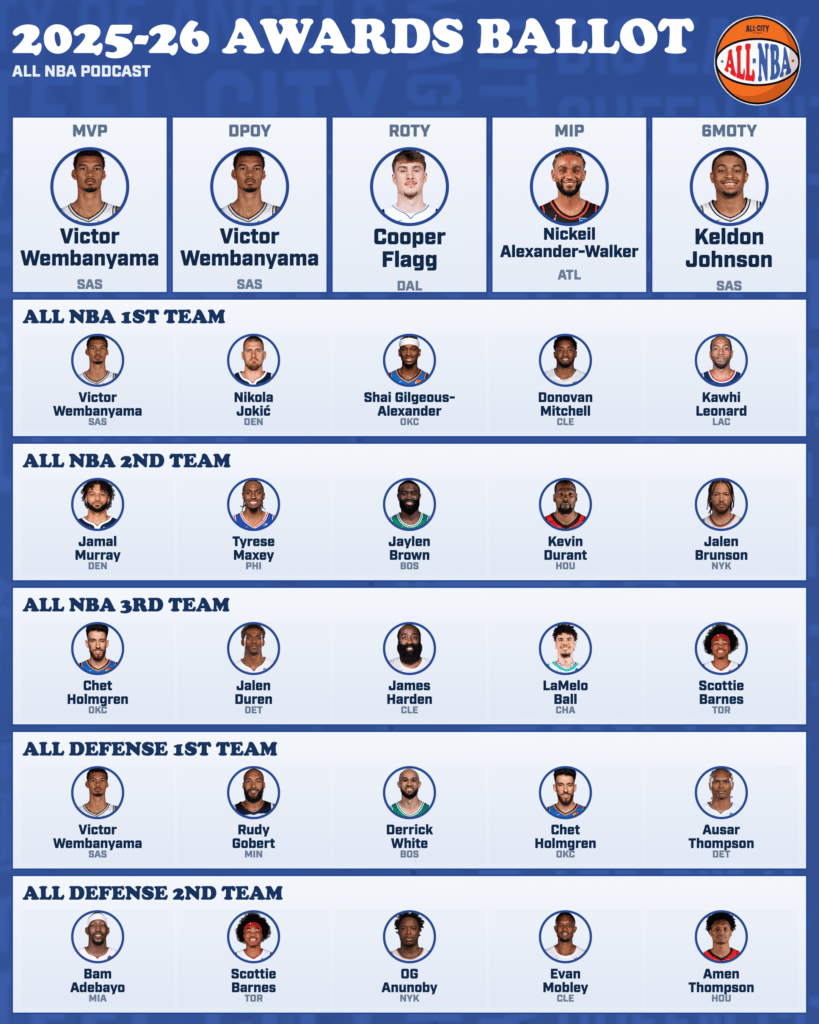
I ended up focusing on the MVP race, as we do every season, with unsaid arguments for many All-Team and All-Defense candidates that I’m happy to elaborate on at a later point. You can reach me by email or Twitter, linked at the bottom, if you need those cases further fleshed out.
MOST VALUABLE PLAYER
- Victor Wembanyama
- Nikola Jokić
- Shai Gilgeous-Alexander
*Luka Dončić
As the NBA has evolved over the past couple decades, it’s mixed statistical inflation with skill explosion. These are some of the most remarkable players we’ve ever seen, point blank, duking it out every season for awards like Most Valuable. All four players atop this list, pending Dončić’s extraordinary circumstances appeal to the 65-game rule that currently has him ineligible, would be worthy winners. You’ve heard or read some sentiment of this dozens of times in the past weeks. I feel it’s too important not to restate it again.
I chose Victor Wembanyama. It wasn’t what I anticipated; I feel sick about this choice. As I type this, there are voices screaming out in my head: How could it not be Jokić? Did you just rank Gilgeous-Alexander third? Are you utterly insane? I will not fight anyone’s alternate choice, not even one for Dončić, even if his candidacy probably has him the slimmest notch below those ahead of him. Since he’s technically not eligible, let’s avoid that conversation. Like I said, I cannot fight against any other argument, not in an awards race as tight as this one. I can only explain what methodology led me to make mine.
Don't like ads?
Wembanyama is the league’s most influential defender: San Antonio allows about 13 fewer points per 100 possessions when he’s on the court. Jokić is the league’s most influential player on the other end: Denver scores about 15 more points per 100 possessions in his minutes. “On-off numbers can be basketball’s strongest statistical measures,” I wrote earlier this season in an article about accurately using them. Gilgeous-Alexander, I should note, has the third-most influence on the court’s offensive side: Oklahoma City scores 11 more points when he plays. I believe these are accurate measures of each player’s hyperbolic impact on this sport.
Offense has historically mattered more than defense: Opponents can more easily detour around a gamebreaking defender than a generational offensive player. (I first typed offender there; it dawned on me there’s a good reason we don’t use bisymmetry for these terms.) But there’s no access road around Wembanyama’s presence. He dwells in his opponent’s minds hours or days before facing him; he created ‘bioengineered’ coaches to account for him before he had even played his first game. What I laid out for his Defensive Player of the Year candidacy still applies. His presence turns every opponent to D’Antonists: These squads took more 3s, more often, with less effectiveness. Perhaps the most specific D’Antonism ideology to describe these teams would be Game 7ists, an unfortunate sect most known for its maligned actions in 2018.
I still almost ranked Jokić first. He’s the best offensive player alive; imagine how demoralizing it must be to defenders to concede layups from defensive possessions that, against any other opponent, coaches would applaud on film. The five-to-nine-foot shot breaks defensive schemes. That’s where coaches want you to shoot from! Jokić took more shots in that area (288) than any other player this season. Among players who attempted even 100 in that region, his 57.3 percent conversion rate of such shots ranked fourth.
In other words: If every single shot Denver’s offense took this season was Jokić taking the shot that opponents most often scheme to allow, without a single fast break or open 3 or foul or shot fake spun into a higher percentage layup, Denver would’ve had the league’s 16th-best offense. That is definitionally game breaking.
I still found myself stuck on one Jokić statistic: When Jokić and Jamal Murray shared the court, Denver’s offense was ungodly, averaging more than 130 points per 100 possessions. When it was Murray alone, Denver fell to an excellent 119 points per 100. Without Murray, Jokić also created sublime offense as anticipated … but nothing better than Murray’s. It was 119.3 points per 100 possessions, a hair higher than the only-Murray lineups, unquestionably exceptional but not quite representational of past seasons where Jokić was the most singular driver of this team’s success.
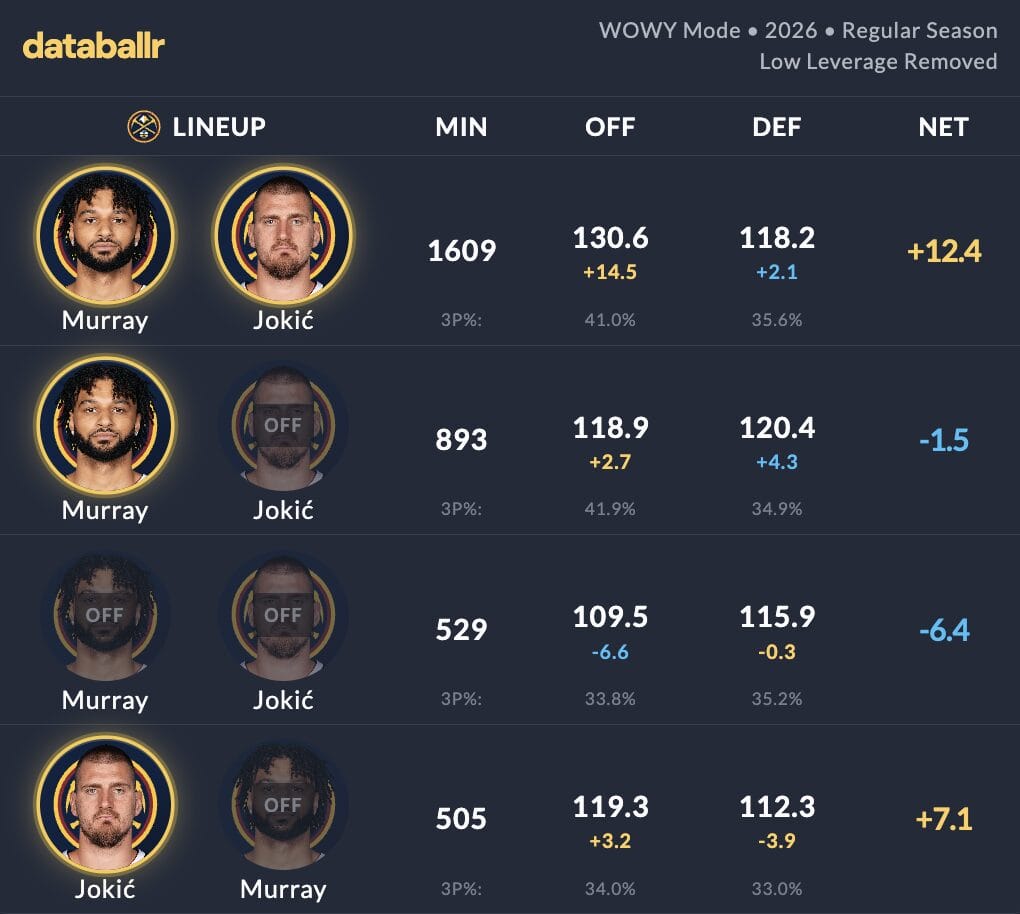
I’ve named Jokić the league’s second-best player this season. Every superstar should benefit from exceptional teammates; Murray will be recognized for his efforts this year later in this piece. The Murray-only lineups had more 3-point variance in Denver’s favor, which Murray’s blistering shooting season alone cannot explain. But we do understand Jokić’s performances had brief patches of inconsistency this season. His defensive impact, nowhere near as dismal as his detractors claim, did wax and wane. His turnovers occasionally spiked in atypical ways particularly in his return from injury.
Don't like ads?
I believe Jokić creates beneficial situations for his teammates to thrive as much as any player in the league. This season, however, he was slightly less impactful than the best version of Jokić we’ve seen, and his teammates were more influential in Denver’s success than any prior year. It was enough, by a single hair, not to award him this accomplishment he has arguably deserved each of the past five seasons (even while winning thrice, of course).
That’s because I can’t find such similar pinpricks in Wembanyama’s defensive presence. (And I do mean pinpricks; these are microplastic critiques.) Wembanyama’s impact numbers came despite his overly qualified backup, Luke Kornet, a known defensive anchor who created great numbers (113 points allowed per 100) when he deputized for Wembanyama. It still was that much better when Wembanyama took over for him. Which, at last, brings us to Wembanyama’s defining argument: That what he does on the court’s other side has its own scheme-breaking influence.
I can’t tell you how many instances of Wembanyama’s vertical gravity exist like this in my notes. This was the very first play from a mid-January game against the league’s best defense, one fully motivated to beat its newfound rival after three consecutive losses, which still conceded a straight-line driving dunk. Because, if the Thunder had played it any different, it would’ve been another type of dunk, one from the 7’4 man in the middle with an impossible catch radius, one which must be accounted for excessively and one who basically eliminated small ball from opposing coaches’ repertoires.
Oklahoma City did win that game above, by the way, because Wembanyama’s offensive effect hasn’t yet become ruthlessly efficient. (He scored 17 points on 15 shots on this specific evening.) This isn’t fair to Gilgeous-Alexander, the presumptive winner in real life, to tumble to third on this fake ballot. But Wembanyama’s presence has created more layups and more corner 3s, which San Antonio converts more often, than when he rests. It was enough, in the end, that I felt comfortable elevating him to this award’s lead despite 400 fewer minutes.
Gilgeous-Alexander adds value to Oklahoma City’s defensive dominance, even passively, because his stout defensive work usually keeps him off another team’s game plan. (You could reasonably argue that sentence undersells his great work on that end.) Then, of course, he serves as the singular reason for Oklahoma City’s scoring success: The closest analog to Jokić’s Murray is Gilgeous-Alexander’s Ajay Mitchell, who’s certainly no Murray despite his superb season.
When first examining this, I was determined to separate Jokić’s counting stats from Gilgeous-Alexander’s quantitatively lower ones. Like Wembanyama, it’s clear how much Gilgeous-Alexander’s presence even when he doesn’t touch the ball creates advantages for his teammates. (It might be as simple as: Guards move more, and with them so do a defender’s feet and eyes.) What most makes Gilgeous-Alexander special isn’t his sheer shotmaking ability, actually. Among players who took 1,000 shots this season, he made about 9.5 percent more than the average player would be expected to. That’s jaw-dropping, but it was lower than Dončić, Jokić, and Kevin Durant.
Don't like ads?
Gilgeous-Alexander’s staggering skill, rather, is that he creates easier shots than his superstar peers while maintaining that divine shotmaking ability. You can picture it: Gilgeous-Alexander on his 15-foot platform, his defender feet away from him, rising up calmly within chaos, creating monasteries within a sport where such space has more value than gold. Once he has the ball with the floor spaced to his favor, he can create these shots at a whim. It’s why, according to the NBA’s gravity metric, he garnered more attention off the ball than any player in the league.
Jokić’s impact still felt every so slightly more than his. Perhaps that’s unfair, and I do already hear the argument: How can Jokić benefit this much from Murray’s season when Gilgeous-Alexander’s second-best scorer missed most of the year? Gilgeous-Alexander’s influence has more weight than his counting stats even if they are inferior to Jokić’s. Denver’s absolute ceiling is its offense, however, and I understand Jokić’s involvement in that. Gilgeous-Alexander single-handedly buoys his own squad’s lesser unit, one which would collapse without him but still have its excellent on the other end.
I don’t know if that’s the right argument. I don’t believe any argument between these three players should be declarative. These are, however, the reasons I chose to rank them in this order.
4. Donovan Mitchell
5. Kawhi Leonard
I’m consistent in my rubric: I tend to weight on-off numbers, should they accurate tell a player’s story, more than most others. Mitchell’s superb season, averaging nearly 28 points with essentially career best efficiency, made him this worthy of a candidate regardless. But when Mitchell stepped onto the court, Cleveland was the team we watched dominate the Eastern Conference last season. (It outscored opponents by more than eight points per 100 possessions.) Nearly everything that went wrong for the Cavaliers, especially earlier this season, happened when he wasn’t on the court.
Leonard was another metronomic scorer, one who finished with his own 28-point average and a staggeringly efficient 62.9 percent True Shooting. He had even more on-court impact than anyone not named Wembanyama or Jokić, but those numbers must be docked for his team’s midseason trade and inconsistent direction, which often meant unserious bench lineups flooded his absences and boosted those numbers. That said, it was a spectacular season from 34-year-old Leonard.
Don't like ads?
ALL-NBA FIRST TEAM
- Victor Wembanyama
- Nikola Jokić
- Shai Gilgeous-Alexander
- Donovan Mitchell
- Kawhi Leonard
*Luka Dončić
It’s the same as above, for the same reasons.
ALL-NBA SECOND TEAM
- Jalen Brunson
- Jamal Murray
- Tyrese Maxey
- Kevin Durant
- Jaylen Brown
Brunson was New York’s offensive engine, not so dissimilar from Gilgeous-Alexander’s role but with more chemistry and defensive questions. His efficiency and 3-point percentage declined ever so slightly, too, which makes him a firm second-teamer without any candidacy to be listed higher. Murray’s excellence was noted above; he drove Denver’s success alongside Jokić and also carried them in his absence. By one metric, no one added more value through jump shots than him. Durant, second on that list, is another easy second teamer.
Jaylen Brown’s a mildly more complicated case, the one player whose on-off numbers paint another story, but I’ve argued was a necessary ingredient that unlocked Boston’s surprising success this season. (Granted, Joe Mazzulla nabbed my Coach of the Year nomination for this reason, too.) Tyrese Maxey had a messier second half mostly due to an excessive workload and his hand injury, but there’s no question he belongs here. No player punishes defenders for rightly respecting when his body shapes for a 3-point that turns into blindingly quick downhill drives more than him.
ALL-NBA THIRD TEAM
- Chet Holmgren
- Jalen Duren
- James Harden
- LaMelo Ball
- Scottie Barnes
Holmgren’s one of the league’s three best rim protectors and paired that with an amplifying offensive effect, too. Duren’s emergence as Detroit’s legitimate second scorer wasn’t entirely unexpected, but it buoyed Detroit’s season-long romp to the East’s best record. Harden leveled back up in his age-36 season to provide creation and shotmaking we’ve watched him deliver for years. I’ve long respected him, his influence on the sport, and even his failures, too.
LaMelo Ball drove his team’s surprising success more than anyone else we’ve named thus far. Charlotte was 9.9 points better per 100 with him on the court; his breakdance dribble creates space that defenses must shift and account for unlike any other player in the league. And, to round out this list, I’ve gone with Scottie Barnes over Derrick White, Karl-Anthony Towns, Bam Adebayo, and Devin Booker, who all had genuine cases. Barnes was the picture of two-sided excellence on a Toronto roster that orbited around his reliability.
ALL-DEFENSE TEAMS
- Victor Wembanyama
- Rudy Gobert
- Derrick White
- Chet Holmgren
- Ausar Thompson
I made cases for the first three in Monday’s column about Defensive Player of the Year; Holmgren was the closest runner-up for his defensive presence, which cannot be denied even if it can be occasionally hard to parse qualitatively due to how much defensive excellence exists elsewhere amongst his teammates. (For example, no qualifying big man defended lower quality layups than Holmgren, per Second Spectrum’s tracking stats, even while his presence still meant they went in less often than would be expected.) Ausar Thompson was the league’s best perimeter defender, point blank, with almost no weaknesses.
Don't like ads?
- Bam Adebayo
- Scottie Barnes
- OG Anunoby
- Dyson Daniels
- Amen Thompson
Adebayo had a quiet season punctuated with one very loud moment, but he delivered his typical defensive quality. Barnes has been covered; OG Anunoby was the most steadfast defender in New York, a slithering athlete who ducks screens without compromising his strength to take on larger assignments. Dyson Daniels’ season, while overshadowed by his shooting woes, was far better than he was given credit for. Amen Thompson might have regressed by a percentage point or two on the defensive end as he was tasked with Houston’s creation duties. The All-Defense first-teamer from last season did not fall off, however, as you might have been led to believe from the conversational absence around him.
Tim Cato is ALLCITY’s national NBA writer currently based in Dallas. He can be reached at tcato@alldlls.com or on X at @tim_cato.
Comments
Share your thoughts
Join the conversation

The Comment section is only for diehard members
Scroll to next article

Don't like ads?
Don't like ads?