© 2026 ALLCITY Network Inc.
All rights reserved.




The NHL‘s regular season is over. The Colorado Avalanche captured the President’s Trophy as the top team in the standings following 82 games. While being the league’s top regular-season team is never a formality, the Avalanche have led the NHL every day since October. While their top seed in the Western Conference was occasionally threatened, the Avalanche remained comfortable throughout the campaign.
When they needed wins, they got them.
The same can’t be said for their first-round opponent, the Los Angeles Kings, who qualified for the postseason in the final week of the season and set an NHL record by appearing in 33 overtime games, finishing 13-20 in them.

Overall, the Kings lost more games than they won, going 35-27-20. Without a historically weak Pacific Division and an astronomical 20 points from overtime/shootout losses, the Kings wouldn’t even have sniffed the postseason. Since the 2005-06 season, only two teams have made the playoffs with a points percentage worse than the .549 that Los Angeles finished with this season.
Under normal circumstances, they wouldn’t be here. But they are, and that means I’m here taking an in-depth look at how the 121-point Avalanche matchup against the 90-point Kings.
Unleash the stats
Let’s start with the team cards first.
Don't like ads?
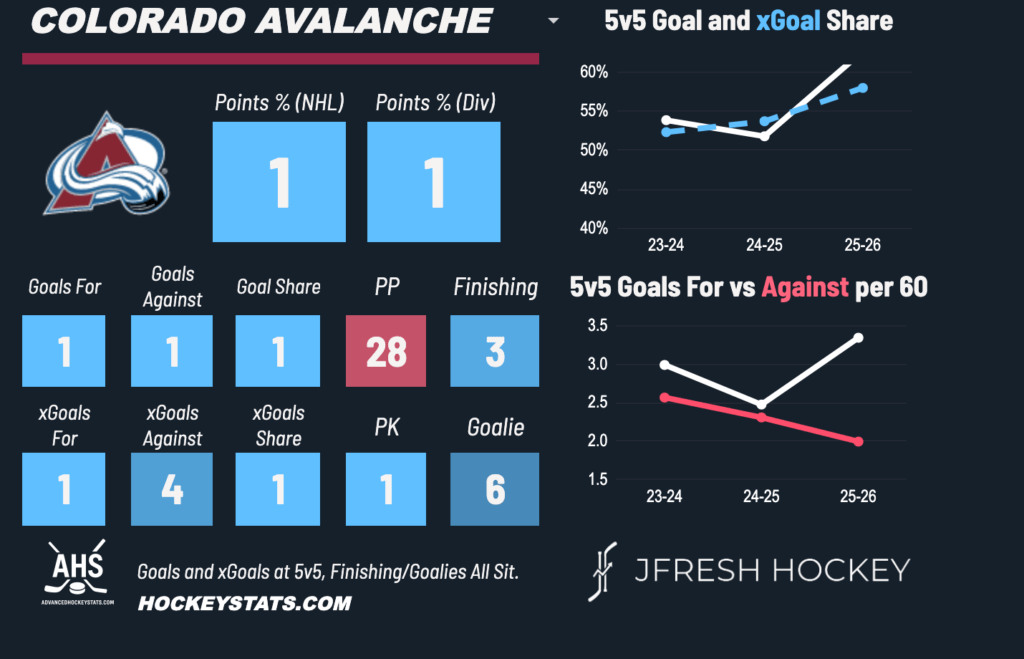
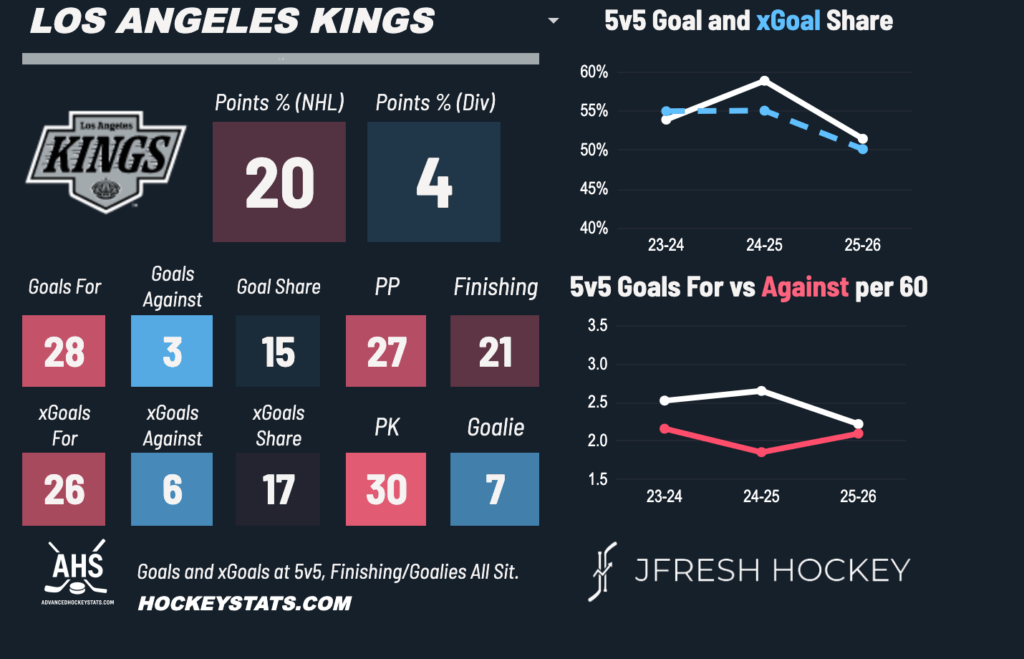
You knew the Avalanche were going to look good in this area, but the Kings are interesting. I want to break down even deeper what their 5v5 per-60 numbers look like, so let’s look at their rates side-by-side.
| Avalanche | Kings | |
| Shot attempts for | 70.26 (1st) | 61.29 (4th) |
| Shot attempts allowed | 53.67 (6th) | 56.09 (13th) |
| Shots on goal for | 33.45 (1st) | 26.94 (15th) |
| Shots on goal against | 25.02 (8th) | 25.24 (9th) |
| Scoring chances for | 33.59 (1st) | 28.12 (9th) |
| Scoring chances against | 24.76 (5th) | 25.62 (11th) |
| High-danger chances for | 13.35 (T-1st) | 12.04 (9th) |
| High-danger chances against | 10.76 (8th) | 10.61 (7th) |
| Expected goals for | 3.21 (1st) | 2.65 (18th) |
| Expected goals against | 2.48 (6th) | 2.43 (5th) |
It tells the story that we were already comfortable with walking in; the Avalanche were a dominant 5v5 team, while the Kings were good defensively but weren’t scary offensively and struggled to generate offense at an elite rate.
This was a special Avalanche team, of course, as they finished tied for the ninth-most points in NHL history. That didn’t happen behind a ton of luck – the Avs created a lot of offense, cashed it in, then excelled defensively and created a soft environment for their two goaltenders, Mackenzie Blackwood and Scott Wedgewood, to have the best season of any tandem in the league.
In terms of overall results, here’s where the two teams ranked:
| Avalanche | Kings | |
| Goals for | 298 (1st) | 220 (29th) |
| Goals against | 197 (1st) | 238 (8th) |
| Shots for | 33.7 (1st) | 28.0 (17th) |
| Shots against | 26.1 (5th) | 27.2 (11th) |
| Faceoff win% | 51.2 (8th) | 49.8 (17th) |
I wanted to include faceoffs just because the Avs were actually good at it this year, but I reiterate that the overall number isn’t very important because the number of neutral zone faceoffs that happen every game aren’t usually that impactful. The ones you really care about are in the offensive/defensive zones, but it was still nice to see the Avs actually showing well in that area after years of being awful in the dot.
Colorado once again shows elite results here, as they proved to be Colorado’s best goal-scoring team while the Kings continued their trend of several years now of not being a good offensive club. Their defense helps keep them in it, but it is really their goaltenders that helped sneak them into the postseason. Let’s talk about those goalies.
Don't like ads?
The Avalanche goaltenders will have to show up
Goaltending is a key component of every playoff series, but against a team that struggles to generate offense and leans on their defense to get by, goaltending is vital.
Let’s compare the goalies.
| Record | Save percentage | Goals against average | |
| Mackenzie Blackwood | 23-10-2 | .904 | 2.51 |
| Scott Wedgewood | 31-6-6 | .921 | 2.02 |
| Anton Forsberg | 16-12-5 | .909 | 2.57 |
| Darcy Kuemper | 19-14-15 | .891 | 2.78 |
As much as the curse of the ex-Avs might come into play if former Avalanche goaltender and member of the 2022 Stanley Cup-winning team, Darcy Kuemper, gets into the net, it is Anton Forsberg, who backstopped Jared Bednar’s Lake Erie Monsters to the Calder Cup championship in the spring of 2016, who is expected to get the Game 1 start for the Kings.
On the other end, it’s been a solid back-and-forth between Blackwood and Wedgewood, but Wedgewood pulled ahead late in the battle to prove themselves as the worthy Game 1 starter for the Avalanche. Bednar has said that he expects his goaltenders to be one of the rare teams to utilize a platoon in the postseason, but if Wedgewood continues his stellar late-season play, it will be pretty tough to take him out of the net in favor of Blackwood.
The advantage that Wedgewood has over Blackwood in that situation is a familiarity with the job of being a backup and understanding that the only day that matters is the one you’re in. Blackwood has struggled a bit more when he hasn’t played games consistently, showing he needs a few games to develop the kind of rhythm that traditional starters prefer. If the Avs are going to actually try a playoff platoon, it stands to reason that it is advantage, Wedgewood, at least to start.
On the other end, Forsberg has outplayed Kuemper by a wide margin this year, but he has played zero postseason games in his NHL career. Kuemper’s greatest run was, obviously, in Colorado and in Arizona in a year the Coyotes were eliminated by the Avs, but it will be interesting to see how Kings head coach D.J. Smith handles this situation.
Don't like ads?
If his team is going to steal a game or two and make this a real series, goaltending is going to be at the heart of the equation. The other aspect of this that stands out is special teams, which is something that has been the talk of Avs land all season.
Are Colorado’s special teams finally special?
Let’s look at some fancy charts and graphs first.


As a reminder, positive numbers on offense are good and negative numbers on defense are good. That means, as you might expect, Colorado’s power play ranks poorly while the penalty kill ranks very well.
It’s no surprise to see the heatmap of shots, either, as the Avs PP is shooting where Nathan MacKinnon and Martin Necas hang out, with Cale Makar in the middle of the ice just inside the blueline getting the bulk of the rest of the shots. They don’t generate anything net front and haven’t made a habit of creating the backdoor tap-ins that good teams such as Dallas have mastered.
On the flip side, their penalty kill does an excellent job in front of their net, although that one little blob right by the net makes me wonder what’s going on there. The royal road problems that plagued Colorado’s PK last season have not carried into this season. They’ve done a great job defending the net and when things haven’t gone as well, the goaltenders have met the moment. It’s been an excellent combination.
Colorado finished the year 27th with a 17.1% power play, while Los Angeles finished 28th with a 17.0% power play. Their penalty kills have gone in opposite directions, however, as the Avalanche finished with the league’s top-ranked PK with an 84.6% success rate. The Kings, however, finished 30th with just a 74.6% success rate.
Don't like ads?


If you’re wondering where things stand since the Olympic break, when the Avalanche actually found some success with the man advantage, that’s what I’m here for.
Since the NHL returned from the United States’ gold-medal triumph in Italy, here are their ranks:
- Colorado PP: 21.4% (16th)
- Los Angeles PP: 20.0% (20th)
- Colorado PK: 84.5% (4th)
- Los Angeles PK: 67.9% (32nd)
That last number was, frankly, shocking to me. How can a team known for its defensive acumen be this awful on the PK? They even added to that unit at the trade deadline, bringing in Scott Laughton from the Toronto Maple Leafs to help the PK. Since Laughton was brought in, LA‘s penalty kill has actually been better than dead-last; it’s been good enough for 31st, with just a 70.2% success rate.
The process hasn’t been great, as their shot attempts, shots on goal, scoring chances, and high-danger chances allowed are all middle of the road, but it doesn’t play like a team that should be this bad. It’s come down to their goaltenders; where Colorado’s goalies have made the saves on the few chances allowed, Los Angeles’s goalies have fallen flat.
Special teams can be a great equalizer for teams that get outplayed at 5v5 (see: Dallas v Colorado last year), but at least on paper, Colorado is entering this series with a significant advantage in this area.
How do the lineups stack up?
This is the last real question for me. It’s tough to preview these because lines change and coaches change their matchup preferences throughout the course of a seven-game series, but let’s see how it might look to start.
Don't like ads?
The Kings have two injured players, forwards Andrei Kuzmenko and Alex Turcotte, who could slot into this lineup, but this was their Game 82 lineup:
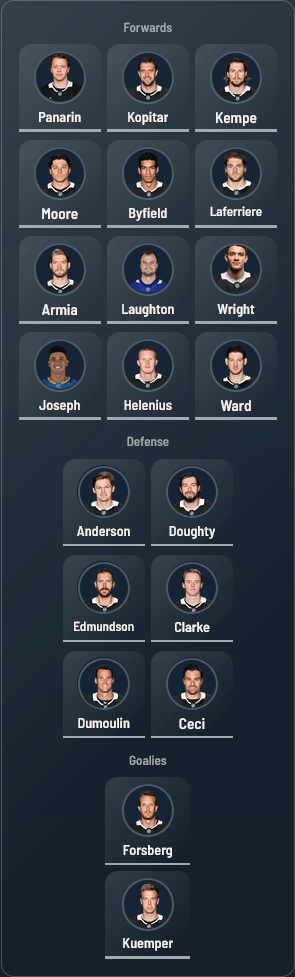
I’m comfortable that the defense from that graphic will stick, but the forwards could be on the move a bit. Kuzmenko, in particular, can help the Kings’ power play (in theory), but he’s an offensively-oriented player who has produced just 25 points in 52 games. Turcotte scored just three goals in 62 games, so we aren’t talking about a major infusion of talent, but the upside exists with both players.
Of the players in that lineup, Laughton and Armia have been the most productive from their bottom six. I’ve focused mainly on that part of their lineup because top players are top players. Those guys are all pretty good.
The difference in this year’s Avalanche lineup is supposed to be its improved depth, so I wanted to start here.
Frankly put, this Kings lineup doesn’t do much offensively. The low-tier offensive output this season is, in part, because of a key injury to Kevin Fiala (injured during the Olympics), but because the bottom of this lineup just doesn’t produce much. Kuzmenko and Armia have produced 25-point seasons and even Laughton’s eight points in 25 games can be considered a step forward.
Basically, everyone else has been a struggle.
Don't like ads?
At the top of the roster, you see a second line of Trevor Moore, Quinton Byfield, and Alex Laferriere. Moore and Laferriere are solid wings, but they have combined for 76 points. That’s not great for a second line, but Byfield could be a major x-factor. He finished with just 49 points, but a late-season surge where he scored 11 goals in 15 games helped drive the Kings’ offense to the postseason.
If Byfield is going at his best, he can be a difference-maker with his size, speed, and skill. If he’s the guy he was for the first 63 games of the season (only 33 points), the Kings are going to severely struggle to generate enough offense to keep up.
At the top, you have future Hall of Fame talents in Artemi Panarin and Anze Kopitar. This is Kopitar’s swan song, but the truth is that in his final NHL season, he just isn’t the same two-way force he once was. He’s great defensively at 5v5, but just 38 points (12G) in 67 games isn’t the production that you would expect from a top-line center.
Panarin has scored 27 points in 26 games as a King, while the always-reliable Adrian Kempe scored 30+ goals once again en route to another 70-point season.
That’s great. Kempe is great. Panarin is great.
They just don’t have the same kind of high-end talent that Colorado does, with the Avs being the only team in the NHL to boast two 100-point scorers and six different players with 20-goal seasons (Los Angeles had four). I’m just guessing what lineup the Avs might roll out in Game 1, but here’s my first guess as to what it could look like:
Don't like ads?
Gabe Landeskog – Nathan MacKinnon – Martin Necas
Artturi Lehkonen – Brock Nelson – Val Nichushkin
Ross Colton – Nazem Kadri – Nic Roy
Parker Kelly – Jack Drury – Logan O’Connor
Devon Toews – Cale Makar
Brett Kulak – Sam Malinski
Josh Manson – Brent Burns
Scott Wedgewood
Mackenzie Blackwood
Compare that to the LA lineup above. Where do the Kings have an advantage?
Their top pairing of Mikey Anderson and Drew Doughty remains stout, posting a 53.75% expected goals for at 5v5 while playing against the opposing team’s best competition. That’s fine, but it should be noted that the Avs outscored LA 3-0 with MacKinnon head-to-head against Anderson this season in just over 17 minutes of 5v5 time. That’s all small sample size stuff, but still noteworthy, I suppose.
The second pairing of Edmundson-Clarke is where the Avs might get some work done. That pairing allows the highest expected goals per 60 minutes, which is remarkable given the reputation of the Dumoulin-Ceci pairing (well-earned). Edmundson-Clarke can generate offense thanks to Clarke’s puck-moving ability and instincts, but it’s the pairing that teams were able to generate the most Grade-A chances against.
If you’re looking for the Avalanche coaching staff to lean into their usual matchup tendencies, which is to let MacKinnon go best-on-best, that means we could be seeing a lot of Nelson going against Edmundson-Clarke. The Kings use that pairing in significantly more o-zone starts than either of the other pairings, which tracks given the offensive limitations of the other two pairings. Colorado likes using the Nelson line in d-zone starts and to eat harder defensive minutes, so it stands to reason these guys loom large as obvious candidates to be going against each other much of the series.
Don't like ads?
As always, the game of coaching chess that takes place will be key in how the series unfolds, but I’m not being a homer when I say that I have a hard time seeing many advantages for the Kings here. A lot of this comes down to them trying to take MacKinnon and Necas out of the action as much as possible and then hoping the poor defensive tendencies of MacKinnon’s line can translate into offense for Panarin and Kempe.
I’m not sure what else the Kings can try to manufacture from there, but as we saw in the Colorado-Seattle series from 2023, sometimes a team just has the horsehoe and that’s how it goes.
What’s the final word?
It’s a bad matchup for the Kings and a great one for the Avs. LA has had bad special teams all year, while Colorado’s were humming along nicely when healthy (as they will be in Game 1). Colorado has offensive punch throughout its lineup and is deep defensively. They have two goaltenders who have been great this season and will push each other for playing time throughout the series.
The Kings lost more games in regulation than the Avs lost all season. Colorado is driven from their bitter playoff defeat last season, while the Kings are just happy to be in the postseason while playing for a coach who still has the interim tag.
These are not organizations that are in the same place right now, and this series should show it. An Avalanche loss in this series would be disastrous.
Comments
Share your thoughts
Join the conversation

The Comment section is only for diehard members
Scroll to next article

Don't like ads?
Don't like ads?