


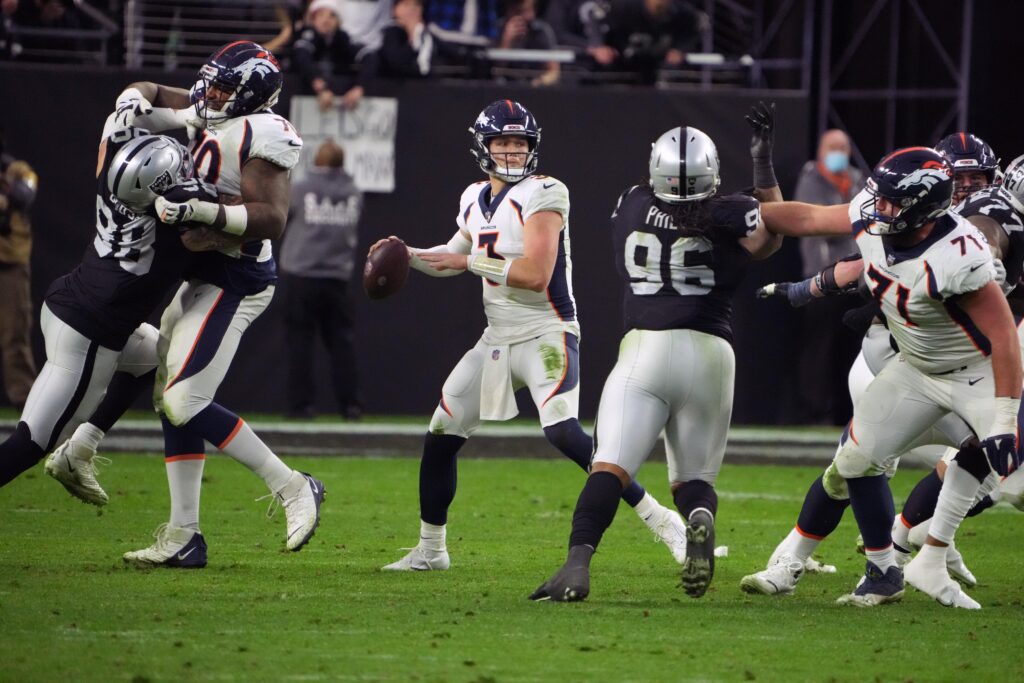
On the one hand, Broncos quarterback Drew Lock did exactly what he could do in his Week 16 return to the starting lineup — with a game plan that was tailored to his strengths.
The two longest completions of the game for the Broncos — a 40-yard pass to Jerry Jeudy and a 20-yard strike to Noah Fant — both came out of play-action. Another near-miss — a potential deep pass down the right sideline to Courtland Sutton on the Broncos’ first series — was also off play-action from under center. When Lock was in the shotgun, a decent chunk of his success came on first reads and checkdowns. He bought time with his movement, too.
Lock played sensibly; most of his passes were accurate, although Fant reaching back to get a hand on a pass that was behind him possibly averted disaster, as two Raiders defenders were in position to potentially intercept the errant throw.
Most crucially, Lock did not turn over the football for just the third time in 21 career games played.
It was progress.
Broncos coach Vic Fangio saw that — but also saw room for improvement.
“You know, I thought he made some good throws. We had a chance on some of them. We didn’t quite make them, but I wasn’t terribly disappointed in his performance, either,” he said. “Obviously, it could be better.”
Of course, the Broncos’ offense as a whole could have been much better. And that made it difficult for Fangio to assess the scale of Lock’s performance, even after watching the film.
“Yeah, anytime you lose your running game — especially for us, that’s what we’ve done best this year — it makes it harder on the quarterback, there’s no doubt about that. And I think it’s hard to give a great assessment of Drew’s play yesterday, because as a whole offensively, we just didn’t play good enough, and it makes it hard to assess the quarterback position.”
With protection breaking down and an offensive line playing on its heels as the Raiders rushed, stunted and twisted their way into the backfield, none of it was enough for the offense to avoid a pedestrian output.
To wit:
- The offense accounted for 13 points, but 10 of them came on drives of 1 and 4 yards set up by takeaways. Just one drive mustered more than a single first down.
- Its 158-yard output in Las Vegas was its third-worst since 1993; the only two games worse in that span also came in the Fangio era — in Brandon Allen’s final start at Buffalo in 2019 and in the quarterback-less game against the New Orleans Saints last year.
- The Broncos had just two drives that netted at least 25 yards on Sunday. With the exception of the QB-less game against the New Orleans Saints last year, the last time the Broncos had so few drives of at least a quarter of the field was on Nov. 26, 2017 — Paxton Lynch’s next-to-last start, a 21-14 loss at Oakland in which the 2016 first-round pick was injured in the second half and replaced by Trevor Siemian.
- Denver went 1-of-10 on third downs — its ninth game with a sub-20-percent third-down conversion rate in the last three seasons. Only the Chicago Bears have more sub-20-percent third-down games in that span.
- And, of course, the offense itself was held to just a single touchdown for the third time in the last four games and fourth time in the last six. In that six-game span dating back to the Week 10 defeat to Philadelphia, Denver has averaged 17.3 offensive points per game, ranking 24th in the league in that span. But if you remove the 38-point outburst against the hapless Lions from the equation, then the Broncos’ average in the other five games is a meager 13.2 points.
The Broncos have failed to surpass 14 points six times in their last 12 games. Only the Browns and Texans have been stuck at 14 or fewer points more often in that span.
If the Broncos offense was in the hospital, it would be in intensive care. Their vital signs would be failing and a Code Blue could be coming next.
“Have we scored enough points in those losses? No, we haven’t, but we have total faith in our players that we’re going to get this turned [around] offensively in these next two weeks,” Fangio said.
Specifically, he doubled down on his faith in beleaguered offensive coordinator Pat Shurmur to revive the attack and generate some momentum in the final two games.
“Pat and I — and the offensive staff, for that matter — talk a lot,” Fangio said. “We have meetings regularly so yes, we do talk a lot about what we’d like the offense to look like, where we think we can improve on a week-to-week basis, taking a look at what we’ve done in the past few week, what we can change up, etc.
“Pat has a long history of being successful in this league, and I’m counting on that happening here these final two weeks.”
Doing so will require reversing so many trends, no matter who lines up at quarterback.

0 Comments (1 conversation)
Mark from CO
Andrew: Say what you want, but Drew was the Broncos best offense performer on Sunday (confirmed by some 3rd party analytics and by the ‘eye’ test). I don’t know if he will become a capable starter or not… …maybe not. But I do know that the Broncos have been terrible at developing him. Progress at the end of his first year, but let’s get rid of his offensive coordinator. New coordinator installs an offense that does not play to Lock’s strength. Covid hits and no offseason. Still progress at the end of the year. Not willing to live with his growing pains (i.e. mistakes), so let’s bring in another QB and have an open competition. A competition which some in the media continue to report that Drew threw fewer interceptions than TB. At the end of the day, Vic has more serious matters to deal with (his job) and selects TB. Perhaps I am rationalizing DL’s continued mistakes. But I don’t think the coaching staff, nor many (if not most) of the media were ready to live with DL’s mistakes as he developed. Vic’s comment yesterday – “I wasn’t terribly disappointed” in DL’s performance says it all. An awful way to describe your assessment of your best offensive player. Yet in poor performances, Vic gives TB the benefit of the doubt, if not kuddos. Lots of words… …in short, the Broncos will continue to fail at QB selection until they commit to a sound development process, and be willing to take the lumps that the process will entail.
Andrew Mason
AuthorBeing the best performer on an offense that had 8 first downs, 158 yards and only two drives longer than 25 yards isn’t exactly grand praise.
PFF ranking: 88.5, 3rd among QBs this week
ESPN QBR: 44.1, 18th
EPA/play: -0.03, 25th
Completion pct. over expected (CPOE): 2%, 17th
Never go by one analytic. That’s why I have always gone for an across-the-board approach. PFF says he was great, to the point of nearly being at Joe Burrow’s level (which is patently absurd). Others say he was average. And clearly Shurmur’s tactics were about minimizing his deficiencies, thus the emphasis on under-center, play-action work and first reads when he was in the shotgun. Lock still struggles to process the entire field when it’s not cut in half out of play-action, which puts a low ceiling on his long-term potential.
Mark from CO
Andrew:
I think you missed my point. My point wasn’t on Sunday’s game per se. (But listening to your colleagues from various media outlets – many say DL had a good game, even perhaps his best given the circumstances and he was not the problem). My point is that the Broncos have done a horrible job developing the QB position historically. I think you can easily argue there is no real process and no real patience to be willing to take the lumps of developing a QB, particularly one drafted in the 2nd round and one who everyone agreed had a (perhaps considerable) way to go. This is a case where many things may be right – DL may not be an NFL caliber quarterback, but it is also true the Broncos have done him absolutely no favors in terms of development. It may also be correct that the Broncos coaching staff, the media and fans do not have the requisite patience to develop a young QB.
One last point. Using analytics on this offense to differentiate what is going on is fraught with danger. The fact is this offense, and with what we’ve been told by the Bronco staff and media is better personnel, is effectively no better with a “better” and “born leader” at QB – TB, than was last year’s offense with a raw and “error prone” and immature QB – DL. Perhaps the real problem is the offensive system, which functions the same no matter who seems to be the QB. A system, I would argue is a QB killer.