


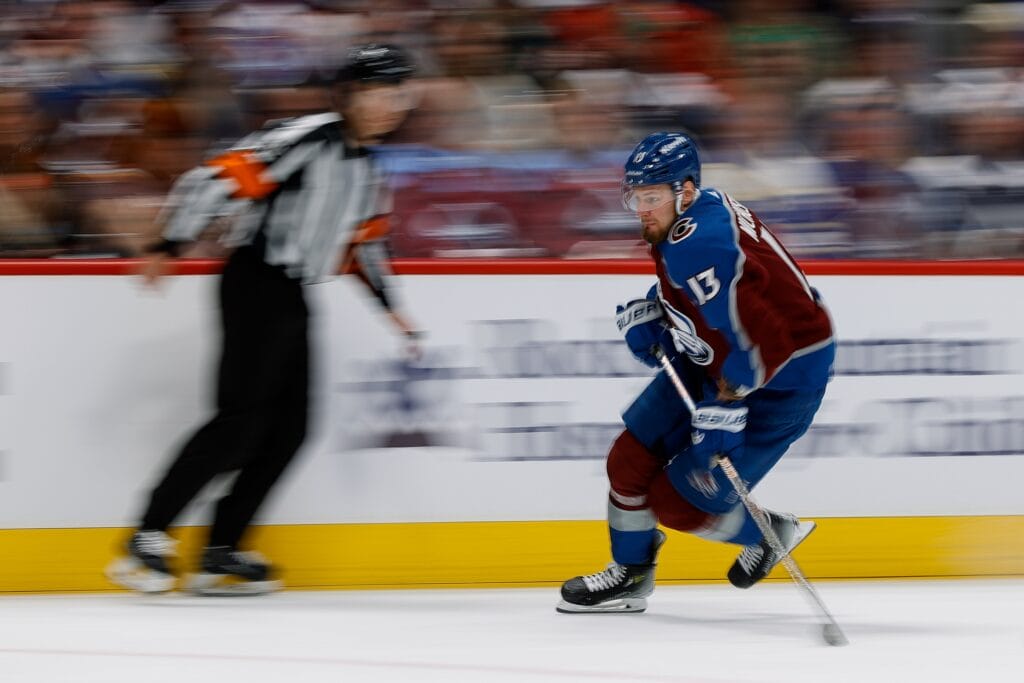
On May 13th it was announced that Val Nichushkin was placed in Stage 3 of the Player Assistance Program of the NHLPA and NHL.
Under the terms of the joint program, Nichushkin was suspended without pay for a minimum of six months and will be eligible to apply for reinstatement after the suspension period.
The news shocked the Colorado Avalanche ahead of Game 4 and ignited a lot of questions about the Player Assistance Program.
Nichushkin entered the program on January 15th, 2024. He was cleared to practice on February 26th and entered the follow-up care phase of the program which meant that care continued to be administered pursuant to the program.
The NHLPA’s Senior Director of Communications Jonathan Weatherley reported that they don’t have anyone available right now for an interview, so there are still many lingering questions about Colorado’s possible course of action, but he did provide information about the program incorporated below.
The program is collectively bargained and has been in existence since around 1996. It was previously called the Substance Abuse and Behavioral Health program and is funded and collectively administered by the NHL and NHLPA.
It also provides resources to family members and retired players up to five years post-retirement.
Two administrators run the program on a day-to-day basis, one appointed by the NHLPA (Dr. Joel Gold) and one by the NHL (Dr. Dave Lewis).
Gold is the consulting psychiatrist to the NHLPA and has served as Bellevue Hospital’s Director of Psychiatric Emergency Services and their Director of the Psychiatric Outpatient Division.
According to ASAPFamily.com, Lewis is certified in Addiction Medicine as well as by the American Association of Medical Review Officers. He’s also the Founder and Co-Director for the National Basketball Association, Major League Soccer, and National Hockey League Substance Abuse and Behavioral Health Programs.
The program provides players with assistance when confronting challenges in their lives around substance abuse and addiction, mental health, gambling, and family matters.
Players who need help speak with the program administrators. Depending on the circumstances, the player may be then referred to a counselor, medical professional or other treatment provider.
The program has a network of medical professionals in each NHL city, and beyond, and players are put in contact with the appropriate resource for whatever issue they need help with.
Players receive annual education on the benefits provided by the program.
Colorado’s NHLPA representative Logan O’Connor said that they go over a range of topics from the CBA to the Olympics and that “there’s always little things that come up within the league to keep guys up to date with.”
O’Connor added that they met in-season to discuss the NHLPA’s new initiative, First Line – an education and leadership program developed to strengthen members’ mental health knowledge and skills.
Players are encouraged to reach out to the program administrators before a problem becomes serious and they learn when an evaluation may be required like in the event of a serious health and safety concern. Players can also seek confidential help by calling a 1-800 number 24/7.
Here are the Program’s Stages:
Stage One – First in-patient treatment; no penalty.
Stage Two – For violation of Stage One treatment plan, suspension without pay during active phase of treatment and then eligible for reinstatement.
Stage Three – For violation of Stage Two treatment plan, suspension without pay for at least six months and then eligible for reinstatement.
Stage Four – For violation of Stage Three treatment plan, suspension without pay for at least one year. Reinstatement not assured.
There’s a lot of speculation around Nichushkin’s situation. It’s not clear what his future in the organization looks like.
“Val is obviously struggling with something,” Jared Bednar said. “I have two thoughts. Yeah, it sucks for our team… There’s still 20-plus guys in that room that care and want to win and that are here. That’s what we have to focus on. It hurts our team. There’s no question. He’s a great player.
And the second one is I’ve gotten to know Val as a person and I’ve gotten to know him as one of our teammates and I want what’s best for him. I want him to be happy and I want him to be content in his life, whether that is with our team or not with our team. I want the best for him and his family. I think all of our guys are the same. We hope that he can find some peace and get help.”
That’s the other side of it. Hockey is not life and death, even though we treat it like it is. Val is a big priority.
Jared Bednar on Val Nichushkin
“And our team is another one,” Bednar added. “Now they are separated. They’re not together. He’s done for six months plus, whatever that looks like… We have to worry about the guys who are on the ice and able to play for us.”
Nichushkin signed an eight year contract extension through 2030 in July of 2022. His contract carries a cap hit of $6,125,000. He won’t be considered for reinstatement before mid-November of next season.
Avalanche GM Chris MacFarland will speak at the conclusion of the season and it will be an inevitable topic of discussion because so much remains unclear about the situation.

1 Comment
Slops
So many of the details of this story are unknown, and really they’re none of our business. That makes just talking about it precarious; I cannot imagine all the pitfalls one faces trying to find people to talk to, gathering info, and reporting like this. Much respect.
Setting aside Val’s health and the damage that has been done to his relationships in the organization, since there’s nothing an outsider like myself can say, what interests me is what the team could do going forward. Since no other players have ever been in stage 3, as far as I know, there are no easy comparisons. The closest things to precedents are probably Corey Perry, Mike Richards, and maybe Evander Kane.
Details with the worm aren’t public, but there was an incident in which he was probably drunk and did something inappropriate or worse. The result was that his team terminated his contract, and he opted not to challenge the termination despite possibly having the legal ground to do so.
Mike Richards was old and no longer worth his cap hit, so the Kings were all too happy to terminate his contract when he got caught with opioids (I think) while crossing the border into Canada. He did contest the termination. The case was set to go to arbitration which would have been all or nothing, and the two parties settled just before that could happen. The Kings were rid of the contract but carried a small cap penalty for the remainder of the original contract’s term.
Finally Evander Kane crossed the border in a way that violated COVID restrictions. Similarly to the Richards case, the Sharks were eager to be rid of Kane’s contract. Kane contested and eventually settled with San Jose for roughly the difference in salary between his contract with the Sharks and his contract with his new team. Since they had room under the salary cap in the relevant time frame, the penalty was “applied retroactively” and it had no real implications outside of the money.
So where does that leave the Avs? Based on the language quoted to describe the Player Assistance Program’s phase 2, Val will “become eligible” for reinstatement in mid November. Based on that phrasing one might surmise that there are conditions he would have to meet, such as staying clean, fulfilling the program’s treatment plan, and possibly passing some kind of review administered by the program, the team, the league, an arbitrator, or some combination thereof. Not comparable situations, but it has been reported that Joel Quenneville could only be hired by a team if that team applies to the league and Gary Bettman “reinstates” him, so there is some context for how reinstatement might be defined.
All of that possibly gives the Avs an out, if they decide that they can’t move forward with Val on the roster. One that the Kings/Sharks did not have, in that it wouldn’t be a contract termination, but rather a lack of reinstatement if Val doesn’t qualify.
So from the perspective of the front office, the crux of the matter is whether or not they will have agency in regards to reinstatement. If they will have the opportunity to decline to reinstate him regardless of any outcome in treatment, then they could choose to move on and allocate his cap elsewhere. If they won’t have a say, and reinstatement means that whenever Val clears he’s back on the cap sheet regardless of their desire, they’re kinda handcuffed cap wise.
An obvious example of how the former scenario might manifest: the Avs know Val’s cap hit is gone, they sign Drouin to a contract, cheap players like Malinski and Annunen fill out the empty roster spots, and Landeskog (if healthy) is on the opening night roster.
If the Avs aren’t free to use Val’s cap space, they probably keep a decent chunk open while they wait for the process to resolve. Wouldn’t necessarily have to be his full 6 and an 8th million, but close enough that they could bridge the difference with some easier transactions. Would be unwise to put themselves in the position to require another team’s help to move significant money mid season, on short notice. The other team(s) would have all the leverage and could extract much value.
Complicating matters even further, the Avs could still want Val, in which case they’d probably be keeping cap free in anticipation of his return. Seems unlikely, but the league could also theoretically give some kind of dispensation to temporarily waive cap hit if Val were to be reinstated, but the Avs didn’t want to have him on the team.
Given the sensitive nature of this whole process, and how tight lipped the Avs are in general, it wouldn’t surprise me if the state of the opening night roster will be the first real indication we get in how the team expects this process to play out.
I’m noodling this all out as I write, and I’m absolutely not an expert in any of this stuff, so many grains of salt are recommended. It’s just what seems logical/plausible to me.