


As the dust begins to settle on summer moves, a clear picture of where the Avalanche stand as a franchise is beginning to form. Like every team, there’s still room to improve, but sweeping summer changes have finally brought a semblance of stability to an organization that’s gone quite some time without.
The 2015-16 season will not only mark the 20th year in Denver, but also the 7th since the beginning of the 2009 rebuild. Years of poor drafting, bad cap management, and trading away draft picks for veteran players left the prospect system barren heading into the ’09 draft, and questionable mid- and late-round selections over the next four years didn’t do much to help the talent pool.
Enter Sakic and Roy. Although the returns are still quite early, their focus on strategic drafting and signing overlooked young players has drastically improved the minor league pipeline. With teams like Tampa Bay providing a example of how successful development can translate into NHL wins, understanding the strengths and weaknesses of the Colorado Avalanche now involves understanding her entire system instead of just the needs of the varsity club.
With that in mind, here’s a look at where the franchise stands, where it shines, and where it can still improve as it heads into next season.
Organizational Depth:
There are two ways to look at the Avs’ depth chart. The first is based on where players are located on the main website, as well as their official position. I further divided the In the System prospects between those signed to a contract (AHL) or those that are not (Unsigned).
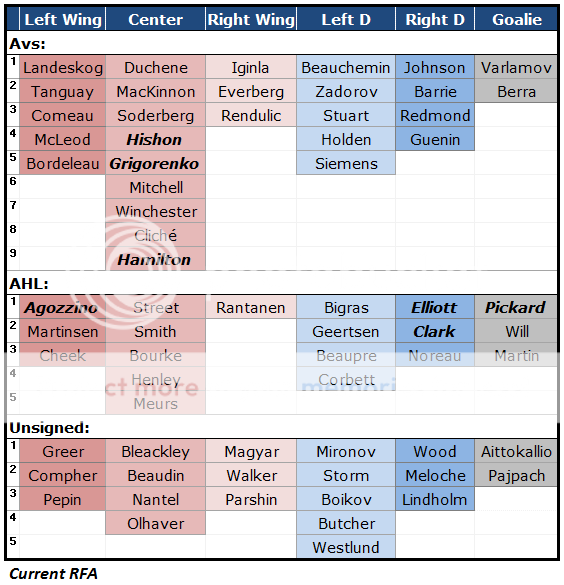
One of the downsides this chart is that it still includes everyone who finished the year with the varsity club due to injury call-ups, which overpopulates the roster and doesn’t give a good idea who will be where to start the year. It also ignores players who often switch to a different position – such as a center playing a wing – on a nightly basis.
Through a bit of guesswork, here’s a better look at how the lines and pairings might pan out heading into the upcoming season.
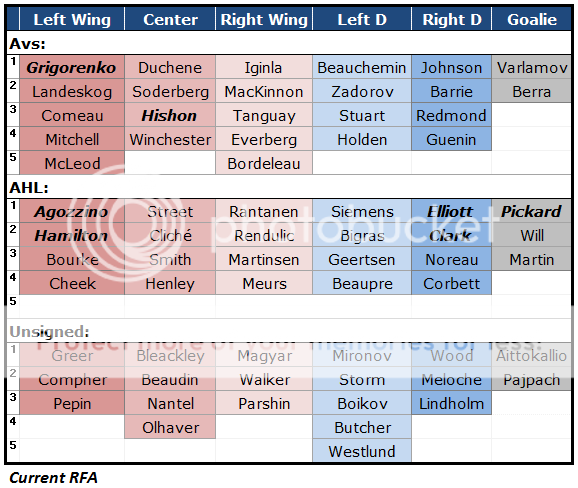
This will likely change depending on how certain individuals preform at camp, but it’s at least a rough idea of how the team stacks up right now.
Organizational Strengths:
Cap/Contract Space: With Mikko Rantanen now under contract, the Avs are sitting with 40 players signed and roughly $10 million in cap space. Even though the 7 remaining RFAs will eat into those numbers a bit, there’s no denying that the Avs will have quite a bit of wiggle room beneath the 50 contract and $71.4 million limits. This creates flexibility for trades and waiver pickups that the club didn’t have last year.
No Glaring Roster Holes: Assuming Beauchemin’s play holds up at a top pairing level and Zadorov can skate in the Top 4, the Avs finally have a roster without obvious fatal flaws. There’s still room for improvement, but it shouldn’t be like last year where the sub-par defense doomed the team right from the start.
Defensive Prospects: While the current defense for the Avs is still paper thin, the crop of young blueliners coming up behind it is anything but. The team has six big, smooth skating blueliners with Top 4 potential at or under the age of 21 (Zadorov, Bigras, Siemens, Geertsen, Wood, and Meloche), plus another 24-year-old puck-mover waiting for his chance (Elliott). Even if most of them never pan out, the Avs should be just fine on the blueline within another 1-3 years due to this shotgun approach.
Strong Core: Even with the departure of O’Reilly, the grouping of Landeskog, Duchene, and MacKinnon at forward, Johnson and Barrie on defense, and Varlamov in net is a great foundation for the team. Zadorov, Rantanen, and maybe even Bigras could establish themselves as part of the group by the end of next season as well. This more balanced approach (as compared to the forward-heavy cores of recent years) should make the Avs a more complete and dangerous team heading into the future.
Call-up Depth: While it’s still not perfect, there is certainly more available for the Avs in the AHL than there has been for years, especially if Rantanen begins his season in San Antonio. The recent graduation of Bigras and Geertsen from Juniors adds them to the growing list of possible defensive help, and the undrafted Andreas Martinsen adds a true depth power forward to the mix. Summer additions to the big club also mean former regulars like Cliche or Guenin could find themselves assigned to the Rampage as well, but either way, the club should be much better equipped to withstand injuries this year.
Organizational Weaknesses:
Aging Defensemen & Unproven Rookies: Help is on the way for the Avs’ blueline, but it comes in the form of veterans who could see their level of play plummet at any time and unproven rookies who are prone to mistakes. If both of these groups start to simultaneously show cracks, the in-their-prime Johnson and Barrie can do only so much to minimize the damage. On paper, the Avs defense is much better than last year, but it’s unclear whether or not that will translate onto the ice.
Depth at Right Wing: The team has found a way around their right wing issue by (hopefully temporarily) moving MacKinnon and others to that side, but the number of natural right wings in the system is almost laughable. To make matters worse, very few of those naturally listed at that position are right-handed shots, which slightly complicates passing between the wing and the center. With Iginla aging, it’s little wonder why right-wing Mikko Rantanen was the Avs choice at the draft, but there’s still much more work to be done at that position.
Duchene’s Left Wing: Even though there’s more depth at the left wing than on the right, there’s less Top 6 potential. This becomes a problem when a center like Matt Duchene relies on chemistry with his left wing in order to be his most successful. With any luck, Grigorenko is the answer to this conundrum, but if he’s not NHL ready or doesn’t establish a synergy with Duchene, it could be another rough year for the 25-year-old center as the revolving door to his left continues to spin.
Defensive Center: Depending on the health of Winchester and the defensive prowess of Soderberg, the Avs could have an issue shutting down other teams’ top lines. The club has lost its best defensive centers over the past two summers, and Duchene, MacKinnon, and Hishon don’t possess the skillsets to fully offset those subtractions at the moment. Luckily, defensive centers aren’t too difficult to acquire via trade, but the extra pressure placed on the defensemen until that player arrives could create some serious issues.

11 Comments (5 conversations)
Forsberger
Great assessment, the team has certainly improved a little overall, and the long term future looks very bright. But I certainly have the same worries you highlight, going into next season (especially how much the D really will be improved). I find it interesting that the “goaltending” was left out of the writeup altogether, but I can see how it’s not really necessary because we look to pretty much set at the most important position in the game!
Truth be told, I’m just so used to Varly bailing us out that I don’t even really think about it anymore. You’re right – assuming Varlamov’s groin is healthy again and Pickard/Berra both bring their A-games to camp to duke it out for that backup spot, the Avs should be set in net. Spencer Martin looked pretty good at development camp as well. Still raw, but intriguing.
Forsberger
My bad actually, realized you did actually mention Varly as a strength being part of the core, but ya he’s so consistently good that it just kinda goes without saying. And ya, it’s certainly nice having a some options for that backup position, Pickard is such a great insurance policy.
Good write-up altogether. I hate when people only point out the parts they disagree with, but see me doing it just as a compliment because I agree with everything else. 😉
My one big point is listing Grigorenko as the first-line left wing? Really? I understand that there is this weakness of Duchene’s left wing. But I really don’t think Grigorenko is the answer. Duchene will need new wingers sooner or later and one will hopefully be Mikko Rantanen. Whoever the other one is, I don’t think it’ll be Grigorenko. At least not this season. For now, I could see a Rantanen-Duchene-Iginla line, though.
I also expect Hishon to start in the AHL, which would put Grigorenko back to 3C. As much as I like Hish, there are arguably better players in the lineup right now.
Forsberger
I’d say Grigs is a bit of a crap-shoot but if he lives up to potential there’s no reason to think he might not be a fit with Duchene. Given Rants is still an 18 year old rookie i’d think it’s much more likely that Grigs makes the team out of camp than him. Rants and Iggy are both natural right wingers too, so I’m not sure how plausible it would be that they end up on the same line. Realistically I think it’ll be Mitchell in that 3C spot. Avs have a lot of options to play with though, will be interesting to see how things shape up.
In fact, Rantanen can play all three forward position and as a left-handed player, his natural position would rather be the left wing. He has played it all in Finland and I believe that he has the potential to make it into the top six this fall.
Forsberger
i think it would be great if he makes it, but there’s no need to rush him if he’s not ready. The fact that he can play in San Antonia is great too, as he can get some seasoning there and still be called up later in the year if needed.
Roy doesn’t seem keen on rushing prospects, so I expect Rantanen to get a season, maybe two, in southern Texas. He’ll be up soon enough, but adjusting to NA ice *not* in the NHL is probably the best thing for him. This way, he’ll be ready to go when Iginla is traded/retires, and as a bonus, the team may even get to slide his contract and delay his UFA years. It makes more sense at this point to develop him the right way.
Also, the Avs top 6 isn’t really a traditional “Line 1, Line 2” setup either – the Soderberg line is likely to be used in a slightly more defensive role, and the Duchene line will probably get more o-zone starts. Grigs, Hishon, and Tanguay are the potential LWs for Duchene, and of those, Grigorenko probably has the most talent for a scoring role. He may or may not work out there, but I bet he’s given an honest look. He’s also on a one-year show-me deal, so let’s see what he brings.
The only way the unproven rookies on defense get to become proven is if they get put in the line-up. Keeping a guy like Siemens in the AHL when he can replace true AHL-level players like Holden and Guenin is foolish.
Great read and insights. The Avalanche weakness at right wing has been an ongoing problem. What about trying a one year contract with Alex Semin? Would a million dollars get him and would it be worth the risk?
Fantastic read and the visuals are great.