


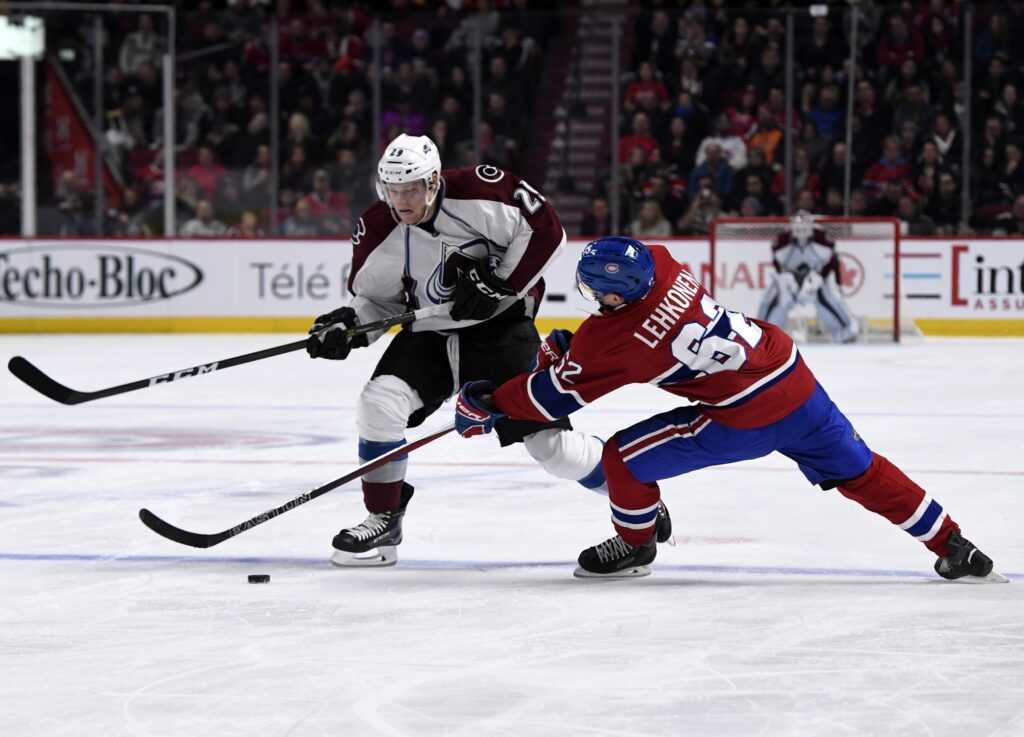
During the Colorado Avalanche’s recent losing skid, there’s been a large amount of talk about the viability of the Avalanche’s core players – Nathan MacKinnon, Matt Duchene, Gabe Landeskog, Erik Johnson, Tyson Barrie, and Semyon Varlamov – moving forward.
After two seasons without playoffs, much of the blame has been laid at the feet of those six individuals, including from the departed former head coach, Patrick Roy. With another early golf season looming, they’ve come under intense scrutiny once more.
But are they to blame for the incredibly disappointing start to this season? Or are they serving as a scapegoat for something else instead?
To find out, I compared the core players to their teammates with over 200 minutes played so far this year. I then pulled the three-year average (’13-14 to ’15-16) for all 17 players and used their current season’s time on ice to calculate what their stats should look like at this point in the year.
First, let’s take a look at scoring.
Offense:
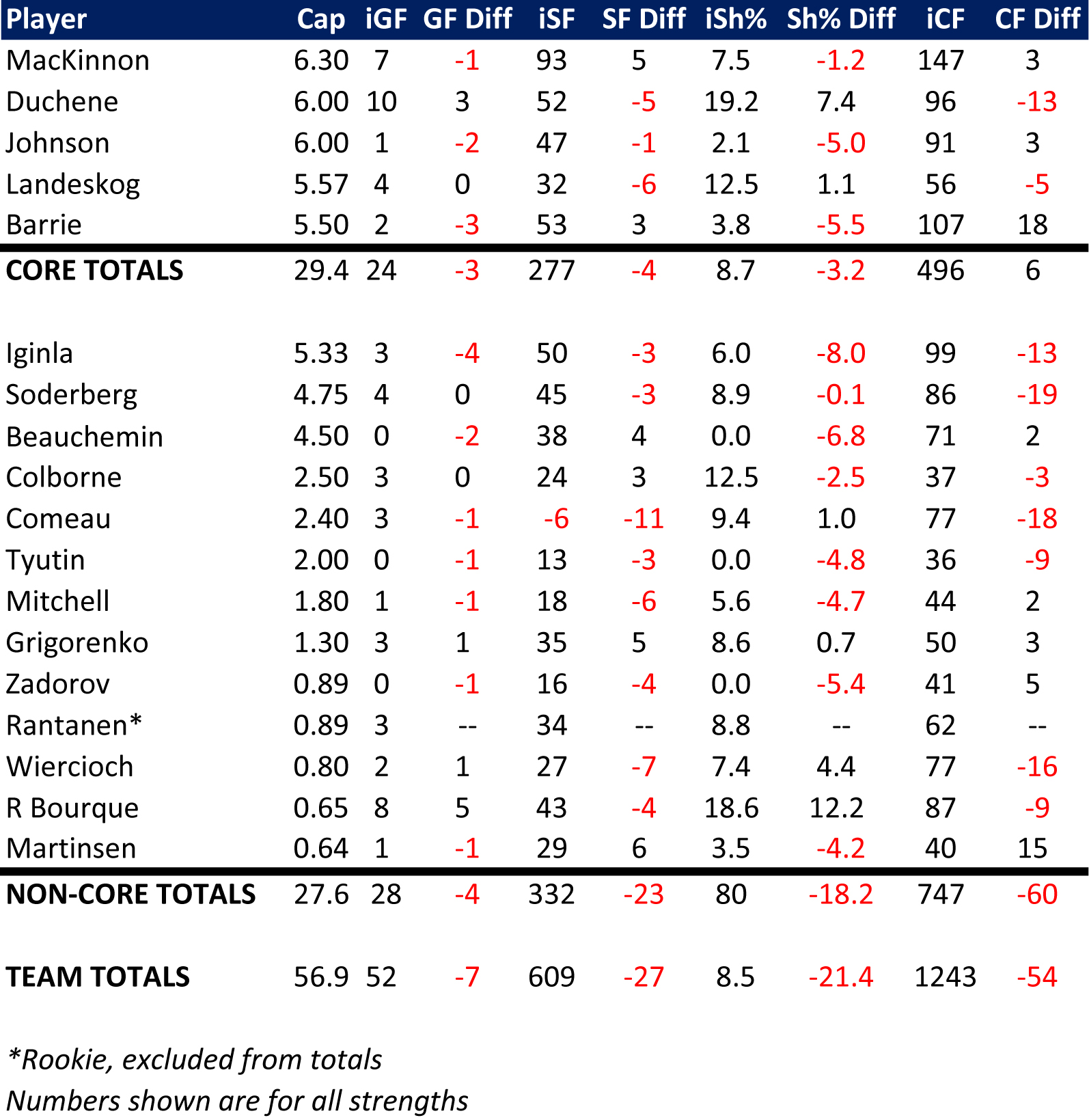
The Avs sit 29th in the NHL with 57 goals scored. (Ed’s note: This was written before the team’s game in Toronto. They now sit at 60 goals scored, tied for 28th with Arizona)** Unfortunately, this is not far from expected.
Even though almost all the players on the team are experiencing much lower shooting percentages than normal based on their three-year average, the club is short only 7 goals. While those goals may have served as the difference in key games, overall, they’d only bump the team to 27th in the NHL in scoring.
Barrie and Jarome Iginla have been the hardest hit, but their losses have been more than compensated by the standout performances of Rene Bourque and Matt Duchene. Even though Duchene refuses to score at the Pepsi Center, he’s still three goals above his expected pace. If it holds, he should finish the year north of 35 tallies. His current shooting percentage makes that unlikely, but chances are high he’ll at least hit the 30 goal plateau again this season.
Part of the team’s overall problem has been a severe decrease in shots. Although the core is fairly close to their normal pace, the non-core players are significantly below theirs. While many of those players played on at least one different team within the three-year window (which could strongly skew their expected pace), their numbers this season are still disconcertingly low.
The Avs, on the whole, are struggling to produce goals. It’s not that they’re getting unlucky; it’s just that they’re not traditionally a very talented group. While the core players are all likely to cross the 20 goal threshold, no one else but Rene Bourque and his ridiculously lucky 19% shooting is projected to even come close. That lack of depth scoring is an incredibly – and possibly insurmountably – large problem for the team.
While that could change as the year progresses, the Avs lack of scoring is less on the core players and more on the management. This group, barring extreme luck or massive stand-out years, was never going to be competitive in the NHL’s scoring race. While it would be nice to see a few more goals coming from the top players, it’s very difficult to blame them – and not General Manager Joe Sakic – for the bulk of the current woes.
** The five missing goals came from non-200 minute players and therefore aren’t represented in the above totals.
Defense:
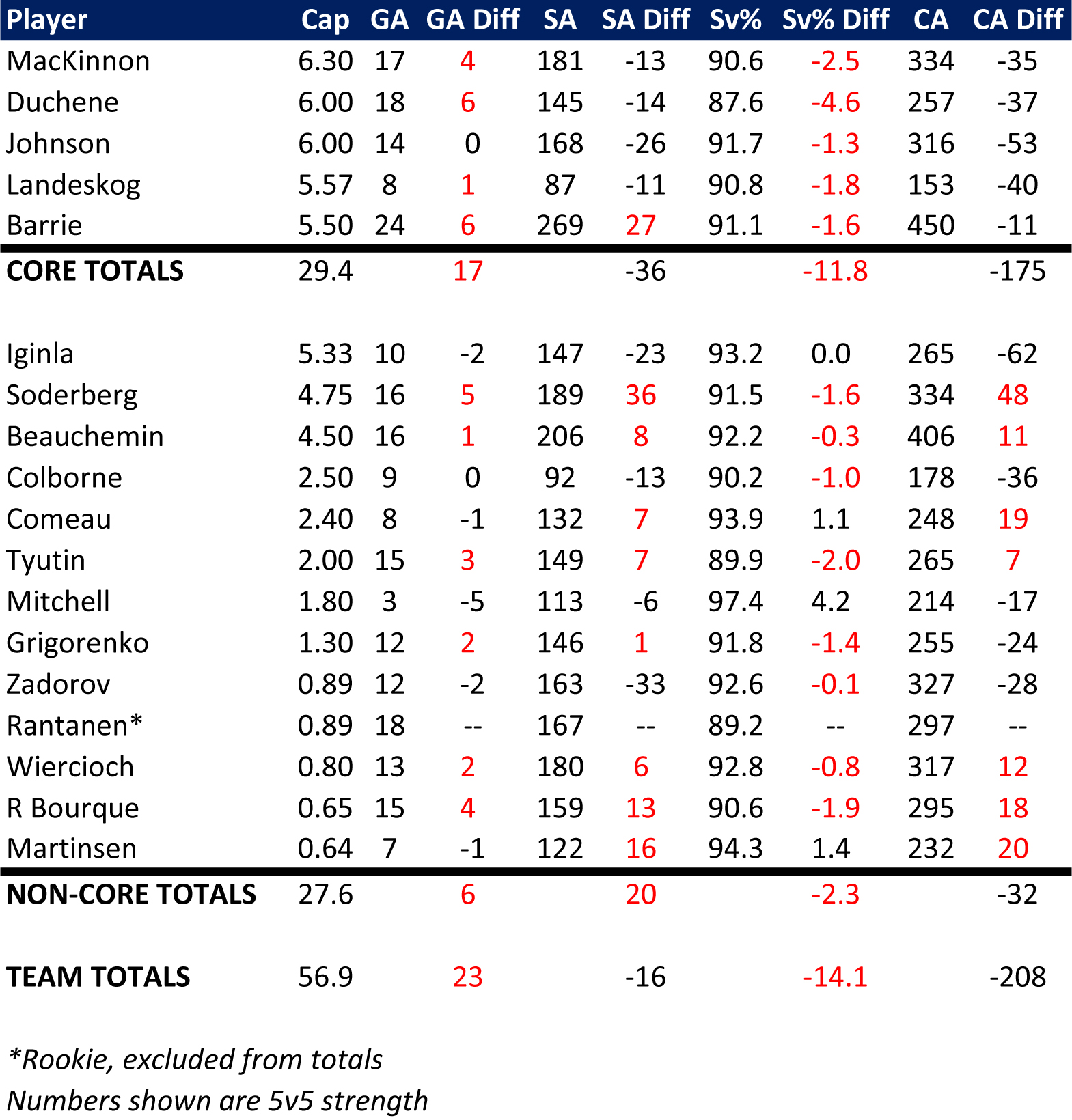
The Avs defensively have been an interesting creature this year, especially when it comes to the core. Their shots allowed are down significantly (except for Barrie), and their Corsi events against have decreased an impressive amount. These underlying numbers indicate Bednar’s system is working: the players that see the ice the most are doing a much better job of preventing the other team from creating scoring opportunities.
However, their overlying numbers – goals allowed – are terrible. Duchene and Barrie have both already seen six more goals at 5-on-5 than they should have at this point on the year.
The culprit? Take a look at the save percentage column. Varlamov and Pickard have only stopped 87.6% of the shots they’ve seen when Duchene is on the ice. For reference, Duchene’s three year average is 92.2%. That nearly 5 point swing is huge, although every single member of the core has received sup-par goaltending. Only 4 of 12 non-core players have seen anything comparable as far as bad play from their netminders.
Also, many of the depth players have shots against and Corsi against rates far worse than their average. Carl Soderberg has been dreadful defensively this year both by his raw numbers and his distance from personal norms. Surprisingly, Iginla and Nikita Zadorov‘s numbers have improved significantly under Bednar, but if they’re removed from the list, the Avs depth becomes rather bleak defensively.
Goaltending:
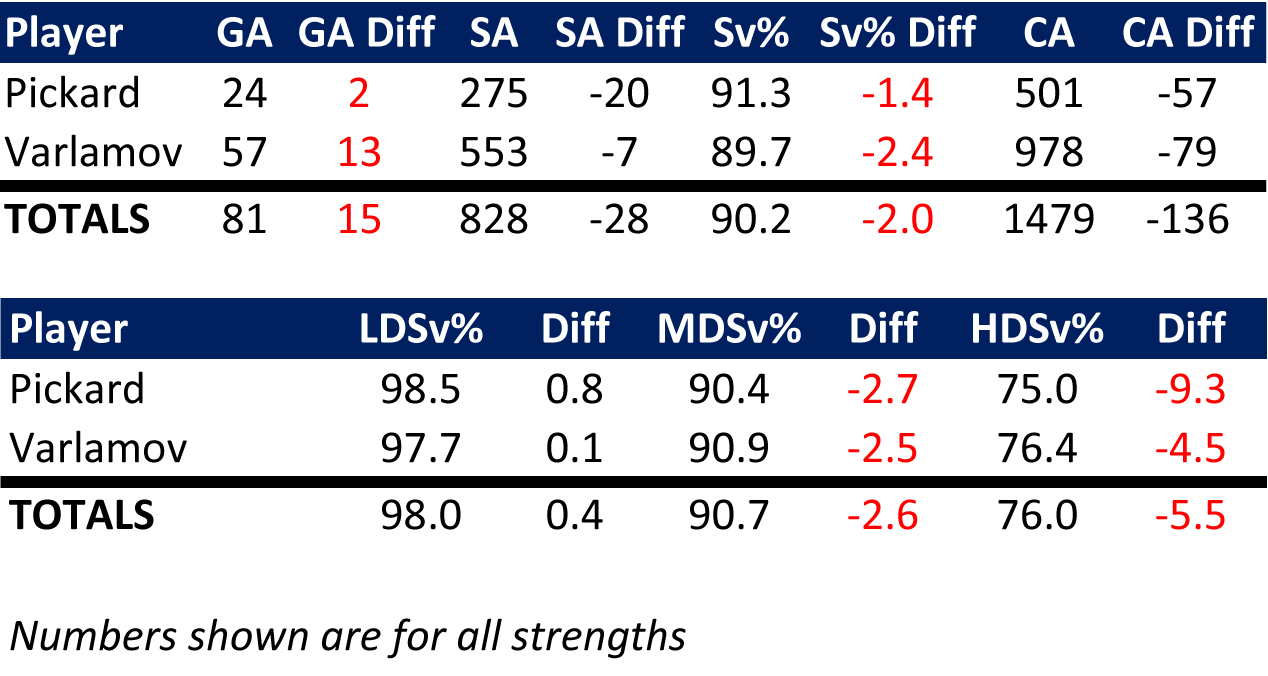
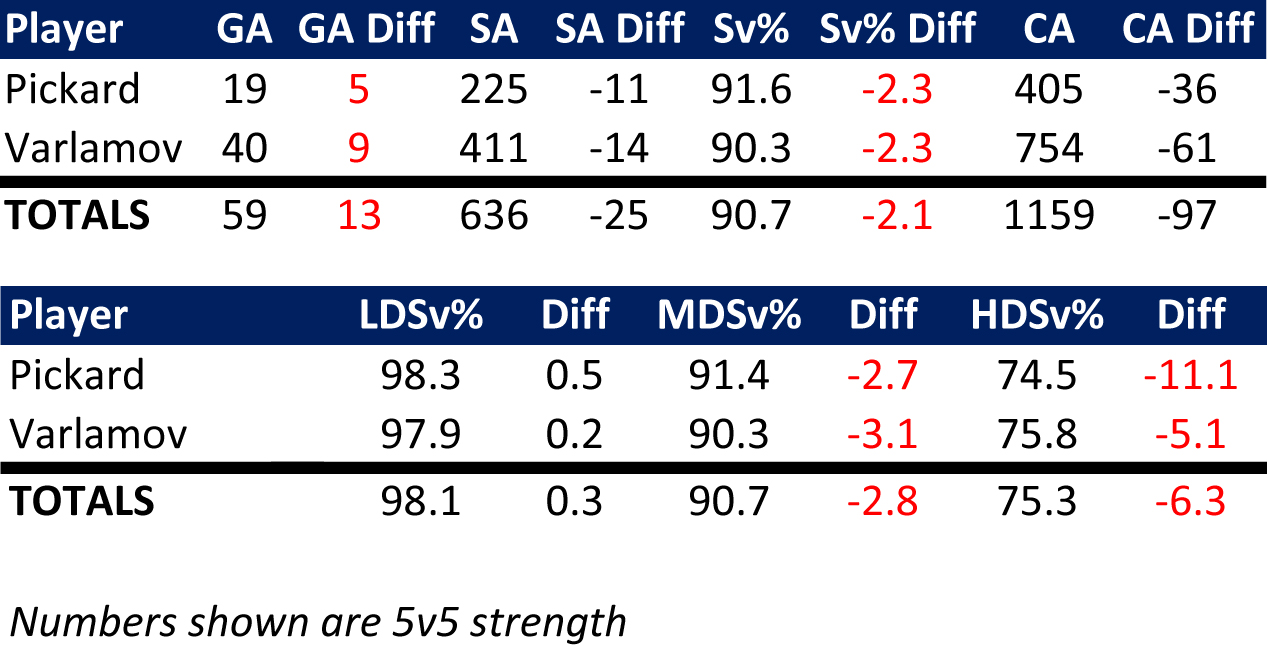
As hinted at above, the Avs goaltending has been exceptionally poor this season. The tandem of Semyon Varlamov and Calvin Pickard have critically under-preformed, allowing an extra 15 goals than their 3 year pace suggests.
Take away those 15 tallies, and the Avs would rocket from 26th in the league in goals against to tied for 8th, and that’s before the decreased rate of shots and Corsi against from a better team-wide defensive effort is taken into account.
Pickard’s totals have made up some ground on the PK, but Varlamov has let in 4 more goals than expected shorthanded. Across all situations, the Avs goaltending save percentages are down, but they’ve fallen precipitously against high danger chances. This is despite the team doing a much better job of limiting chances against, including decreasing the opposition’s high danger shots by 6. It’s not much in the scheme of things, but it points to goaltending – not the defense – as what’s driving the save percentage numbers down.
If you’re curious just how poorly is preforming based on their averages and that of the league, Varlamov is the big red bar at the bottom of this graph:
Goalie Rankings via xGS : 2016-12-11 pic.twitter.com/VPfzPS3ttZ
— DTM About Heart (@DTMAboutHeart) December 11, 2016
Who’s To Blame:
So, is this season the core’s fault?
In the case of MacKinnon, Duchene, Landeskog and Johnson, the answer is no. While their offensive production might be down slightly, it’s certainly far from critical, and a moderately warm streak will quickly return it to norms. In today’s league, top six players are expected to produce 20+ goals, and barring injury, all three of the forwards should hit that mark with relative ease.
Defensively, all four have improved significantly. While their numbers still aren’t great in comparison to the league, given the quality of their teammates, they’ve preformed as admirably as can be expected in the face of long odds.
Even if they were to be traded, it’s unlikely the Avs would make a net gain statistically. Shipping them out would be the equivalent of shuffling deck chairs on the Titanic. While it might pacify fans for a time, there are much larger issues at play.
Unfortunately, in the case of Barrie and Varlamov, the criticism is warranted. Barrie’s never been outstanding defensively, but in the past few seasons, he’s established himself as an adequate top four option. This year, he’s allowed far more shots against and hasn’t improved his Corsi against at the same rate as the rest of the core. Perhaps he’s struggling to find chemistry with a new partner or adapt to Bednar’s more regimented system, but he’s turned the Avs second pairing into more of a liability than anticipated.
The puck-mover’s offense is usually enough to cover up his occasional defensive warts, but even that’s not worked well for Barrie. His shot and Corsi for totals have jumped slightly, but his shooting percentage is languishing. Luckily, this more the sign of bad luck than any sort of a step back, but it does amplify the pressure on his mistakes at the other end of the ice.
When it comes to Varlamov, no single other player is more to blame for the record than he. His numbers are frighteningly low, and Pickard’s totals aren’t much better. While it’s unlikely either netminder remains this far below career averages for the full season, they both have severely let down their teammates so far, especially given the much improved defensive effort the skaters have shown in front of them.
Whether it’s an adjustment to facing fewer shots or mental uncertainty over the looming expansion draft, the goaltending has been inexcusably putrid in Colorado all season. Any sort of a turn around will begin from the net out, and it’s ultimately up to these two individuals where the Avs will draft next June.
However, the true blame for this season is at the feet of Joe Sakic. While he’s shown improvement since the mistake-ridden 2014 offseason, this roster is not built to be competitive. On paper, it looks fine, but after digging into the underlying numbers, it becomes clear that there is very little offensive or defensive talent beyond the top players.
Whereas most teams in the NHL are capable of icing 7-9 forwards and 3-4 defensemen before a large drop off in talent, the Avs have 3-5 adequate forwards (MacKinnon, Duchene, Landeskog, Rantanen, and defensively Iginla) and around 2 decent defensemen (Johnson and Zadorov). Even if Soderberg and Barrie were having worthwhile years, the team would still need unexpectedly strong performances from players like Mikhail Grigorenko, Rene Bourque, and John Mitchell to even come close to average.
While the poor play of the goaltenders is certainly a major factor, in the end, the Avs are just not a very good hockey team. After eight years of failed development, the Avs are still in a rebuild. While prospects like AJ Greer, JT Compher, Tyson Jost, Chris Bigras, Duncan Siemens, and Spencer Martin provide rays of hope, Sakic has a ton of work ahead of him to clear out overpriced and inefficient depth. Only then will he be able to provide his core players with the support they need to pull the Avs from the league’s cellar.

0 Comments (1 conversation)
Sorry, this is going to sound a little crass so I’ll apologize from the start and get that out of the way.
Ok, so I’ve got a masters in economics and I’ll spare you what I do for a living, but this type of what I call “armchair analytics” that has been happening in the hockey community the last 2-3 years is what drives me insane. I follow baseball religiously too and I cannot remember this happening during their statistical renaissance.
Lets start simple. You are standardizing your comparison of MacKinnon, et al to their 3 year average (’13-’16), great. So lets take a look what that’s really saying. Two of the 3 years in that base window were ‘down years’, so out of the gate we are comparing to what eyeball test (or even hero charts) would call under-performance. Let disregard growth factors, line combos, favorable matchups, all that good stuff and just stick with that.
To just look at the data you collected and say “player X is slightly(?) under-performing previous under-performance” should NEVER draw a conclusion that they are fine/not the problem. A more accurate conclusion might be, “they weren’t the solution then, and they sure as heck aren’t now”. A more accurate test might be, comparing MacKinnon to top 5 forwards/centers taken in the last 10 years. Comparing MacKinnon to other 1st line centers around the league. I’m choosing to pick on MacKinnon here because first he is my personal favorite player on the team, and second his results 3 years in have frustratingly never matched up to what our own two eyeballs tell us he should be capable of, and he seems down that path once more. His shot totals are through the roof, yet his G/60 and 1stA/60 are so subpar again.
Another player, Gabriel Landeskog, has declined going on 4 years in a row now. 24 year old players do not decline 4 years in a row. Big red flag. Lets deep dive that for a moment.
I don’t understand this website’s desire to scapegoat varlamov and goaltending in general. The offense has been basically DEAD LAST in the league in goals all season.
I’ll say again, DEAD LAST in goals.
I don’t care if you park a Volkswagen bus in front of the net, if you don’t score whats the point. Even by your own analyst Varlamov has gone from standout goaltender to below average. Saying that another way, he’s gone from hiding this teams many blemishes to leaving them fully exposed.
The problem is the many faces of this team, the core (boy I hate that word), have never and continue to not produce at a level that will ever allow a team to compete. If your barometer for a successful Nate MacKinnon is scoring 20 goals in a year, then we need to have a separate discussion about expectations. If you draft a player 1,1 and say “I just hope he gets to 20 goals” that’s a problem. We’re skewed heavily by recency bias, but trying to blackout from our minds the other worldly drafts of the last two years, Nathan MacKinnon was highly regarded as one of the best prospects in some time his last two years in junior. We’re in year 4 now and he flat out has not lived up to expectations. I’m not saying to trade him, he’s actually the lone guy I would keep in a total tear down, but to say he’s just fine as the leader on a team last in goals is absurd.
TLDR: Your justification to say the core is not the problem is heavily flawed. A cursory, misguided approach is not going to yield meaningful answers. Asking the right question is the most important step.
Cheers.
The entire point I was trying to make is that we only have three top 6 forwards. They’re by and large producing goals as top 6 forwards should. However, if you’re expecting three players to do the work of six while dragging around 4th liners, of course it’s not going to end well. It’s like blaming them for not doubling expectations while playing against a stacked deck.
You’re not wrong – we need more production from MacKinnon as he grows into his game. But if he only hits 20 goals instead of 30 this year, we’re out 10 goals. That’s upsetting, but it’s a small fraction of the 50+ we’ll be missing from our depth as compared to an average NHL team, or the 150+ we’ll be missing from the good ones.
The root of the problem isn’t the six core players – it’s that the core isn’t big enough and has no help. This isn’t an issue that’s going to be fixed by swapping out the top players for other ones – it’s only going to be helped by filling out our top nine and second pairing D with more talented options.
I have zero clue where you’re getting good teams getting 150+ goals from their “depth”. You know the league average last year was 222 goals for the entire team, right?
It seems by your definition, and correct me if I’m wrong, but ‘secondary scoring’ is anything outside of the top 6 forwards and top 2 defenseman, yea? And that seems to be the 2nd finger BSN points to after it gets tired of pointing at Valamov.
So I ran some quick numbers for you. Last season the Colorado Avalanche received 75 goals out of 216 total goals scored from ‘secondary scorers’, for 34.7% of their total goals scored.
Now you say good teams get 150+ from theirs, (well you actually said they get 150+ MORE goals than colorado does, but I’ll leave it at just 150). Looking at the two stanley cup teams, might be considered as ‘good teams’, who were also 3rd and 4th in the league in total goals scored. SJ Sharks got 63 goals from ‘secondary scorers’ out of 241 total goals (26.1%). Penguins scored 77 out of 237 (32.5%).
So pace out what the same definition of those players are doing for the Avs this season, and their 82 game pace is 58 goals. So yes, that is 18 goals down, but its also near to what say the sharks put out last year in a cup run. In actuality, it appears from a quick glimpse that secondary scoring for the Avs last year actually overperformed, so to scapegoat them for not over performing again this year is fairly shortsighted. (to round it out, top 6 last year did 141 and theyre on pace for 124 this year, so slightly under-performing as we previously discussed.)
I’m not blaming any ‘core’ player for not doubling expectations, I’m blaming them for not even coming close to single expectations. Ever. I’m more so blaming them for experiencing zero growth throughout their careers in Colorado. That’s a problem. Huge problem. Unless you’re Mike Trout or Connor McDavid who’s career arcs will just be a flat line at the top, every player has a pretty consistent trend upward to a certain age across all sports. Our players have had nothing of the sort. Here’s MacK’s goals per game each season of his career:
.29
.22
.29
.30
Zero growth. That’s the biggest issue here. You saying “as he grows into his game” really bothers me too like we need to give him time or shelter him. He was widely compared to Stamkos for his goal scoring his draft year. Stamkos had three 40+ goal season by year 4 playing on similar teams! MacKinnon’s age adjusted junior numbers were most similar to Tyler Seguin. After his sheltered rookie season on a stanley cup team Seguin has never had a season below .33 goals per game and hit 37-47-84 in his 4th year!
I mean, my point is how much longer would you be satisfied in giving MacKinnon before we can focus in on his lack of carrying the offense? Big players have to step up. If you’re waiting around for the little guys you’re done.
He’s no an isolated case either. Landeskog has declined. People have jumbled numbers around to try cover for him and justify he’s contributing in other ways, but the fact is this is out of the norm. This is the center of the universe for people’s frustration with Duchene. 8 years now and people just keep hanging on waiting for that next step.
This is how organizations sit in 20 year holes of purgatory. Its already been at least 10 for the Avs. How much longer do you want to wait around for the big guys to be big guys? I could careless about the goalie. You can find goalies. Draw any squiggly line on the paper in front of you and you’ve got the career arc of every goalie in the last 15 years. They’re the outlier that is all over the place. Don’t pay em long term, end of story.
The real question with this team is why have none of these guys developed/progressed in any predictable way? We don’t know and that’s how we end up with all the conjecture of “team has no heart” “kids these days” “coaching’s the problem” “front office is the problem” “players don’t like eachother” “#vegastripthesequel” etc etc etc. I’m at fault here too. I personally think putting the C on landy the way they did harmed his development, but there too I have ZERO proof of that.
But we’ve pretty much crossed off all possible guesses at this point aside from actually moving one of these guys. Teams seem more willing to do 1 for 1 comparable talent trades now. I still think if we passed on Barrie for Taylor Hall that’s awful. But why not a Duchene for OEL, or Landeskog for Saad. Something like that, a shake up. I’m not here to debate those exact trades, just the nature of those deals.
I think the salient point you make is about comparing this year’s down performance with last the last 3 years of underperforming. You’re right, the expectations of these high draft picks absolutely have to increase as their young careers progress, unless you’re willing to concede they’re essentially all busts. I’m not willing to go there with MacKinnon just yet, but I definitely expected more from 3rd overall Duchene and 2nd overall Landeskog by this point, and I wouldn’t be opposed to dealing either one of them (especially Duchene, while his value is high for however briefly it is).
And as much as it pains me to say it, as a goalie myself, Varlamov probably needs to be moved as well. I loved the trade when Sherman brought him in, but he looks and plays like a guy who desperately needs a change of scenery. Scenery that doesn’t include Tyson Barrie getting consistently walked or Zadorov blowing another assignment going for a glory hit.
All signs point to there being a need for another total rebuild, not yet more supplementing this flawed and underachieving “core”.
I’m not sure where you expect to find these more talented defensive options if not through trading away some of the underperforming top end forward pieces. The reason top flight d-men are highly paid is because they’re rare. I also don’t see the second coming of Drew Doughty stepping off the plane from San Antonio either.