


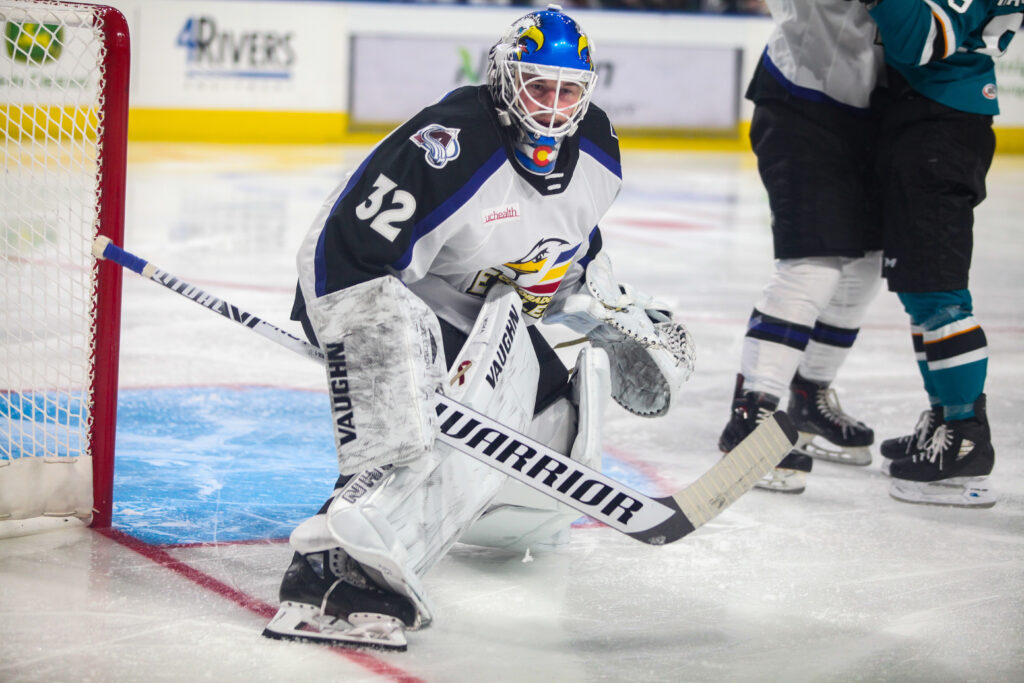
In a game eerily reminiscent of one last March, the San Jose Barracuda came into the Budweiser Events Center the night after a loss to emerge victorious in a lopsided affair to snap a Colorado Eagles’ winning streak.
Last season, it was an embarrassing 9-0 loss at the hands of the Sharks’ top affiliate that erased nine consecutive wins; on Saturday night, it was four goals in the first period that prevented the Eagles from making it five-straight victories during a 4-0 loss.
The early onslaught culminated in goaltender Adam Werner getting pulled after the first intermission. In his stead came Hunter Miska for the first time in the 2019-20 season.
“It felt good to get back in there,” the 24-year-old said of his appearance for the final two periods. “It’s been a couple weeks since I’ve been in a game situation. Working pretty hard in practice getting ready for the game routine stuff. So, everything’s been paying off.”
Before taking his place between the pipes on the southern end of the ice, Miska had some kind words for Werner after allowing those four goals on just seven shots. “I told him to keep his head up. He’s done a lot of good stuff so far this season. You have a bad game here or there. Nothing was his fault. We just had some bad bounces out there. The ice wasn’t the greatest tonight. He’s going to compete and he’ll be ready to go next game.”
Regardless of the setback, Werner had been playing rather impressively during a recent spate of games, going 4-1-0 in the previous five Eagles games with a 2.38 goals-against average and a .927 save-percentage; over the four-game win streak, the 22-year-old was a major factor, putting up a 2.19 GAA and a .934 save percentage.
Biding his time from the bench, Miska was able to pinpoint the efficacy of the team through the spell of victories, citing speed as the biggest factor in addition to Werner’s strong play. “We’ve gotta be fast up the ice. Play a 200-foot game,” he explained. “Get a lot of shots on net and get bodies in front of the goalies.”
Centennial State hockey fans may remember Miska best from his performance against the University of Denver in the 2017 National Championship game where he stopped 25 shots for the University of Minnesota-Duluth, ultimately losing 3-2 to the Pioneers.
“It was a pretty surreal experience. That’s your goal in college hockey: make it to the Frozen Four. We came a goal short in that game, but it was a pretty sweet experience getting the opportunity to play there and put UMD out there.” Alluding to the Bulldogs championship in 2018, he went on to say, “They’ve shown that they’re a top team in college hockey the last couple years, so it’s pretty awesome to see.”
Though he went on to sign a two-year, entry-level deal with the Arizona Coyotes soon after, Miska hasn’t forgotten getting overlooked as a viable goaltending stud. “Obviously, being a free agent, I got passed up in the draft,” he confessed. “I use it, feel it. I work hard every day. I have a pretty strong work ethic and I don’t really let anything get to me.”
After two seasons with the Tucson Roadrunners, Miska was a free agent once again, albeit for a little more than two weeks. “It was a pretty easy decision,” he said of the one-year pact with the Avalanche. “They came knocking on the door right away. And I loved playing here when I was with Tucson. I know they have great fans and a super great organization. Hopefully, I can grow with these guys.”
While he certainly would have preferred his first Eagles game to be something more than just mop-up duty in a 4-0 thrashing, the 2017 Mike Richter Award finalist for the NCAA’s best goaltender made the most of his opportunity, stopping 24 shots including four during two PKs in the third period.
“It was awesome for him to step in like that,” captain Mark Alt said of Miska’s play. “Still saw a lot of shots and traffic in front of him. I thought he played outstanding.”
Takeaways
- “We just needed a spark, somewhere,” Alt said of the team’s 0-for-5 performance on power play. “Kudos to their goalie (Josef Korenar). He played great, but we were hoping to get one of those bounces. At least give us some momentum and get us going in the game.”
- In the second period, Alt scrapped with Barracuda assistant captain Jeffrey Viel, getting in a good right hand before referees squashed the fight. Asked if the impetus for the dust-up was to spark the Eagles, Alt said, “Maybe out of frustration. The game’s not going our way, a lot of battles in front of the net and at some point, you let loose a little bit. I thought we fought hard, especially in the third period. It was just sloppy.”
- After the Eagles scored twice within the first three minutes of Friday’s game, it was the Barracuda who’d sink their teeth early in Saturday’s contest with four goals in the opening period on seven shots.
- Before going down 0-1 in penalty kills early in the first period, the Eagles entered the game having allowed only three on the season, placing the club 9th in the AHL in PK% (87.5).
- Eagles have led the league in penalty minutes this season, averaging 24.5 PIM’s per game entering Saturday’s matchup, and stand atop the league with seven major penalties. In the October 19 matchup against the Milwaukee Admirals, Colorado posted 80 penalty minutes, the most in an AHL matchup all season. Forward A.J. Greer earned 40 PIM’s and was ultimately suspended for six games after he left the penalty box to fight Admirals’ captain Jarred Tinordi during the contest.
- Former Eagles defenseman Nicolas Meloche laced up for the Barracuda against his old squad. The 24-year-old was traded to San Jose on the eve of the regular season for goaltender Antoine Bibeau, who did not get an opportunity to play against his old club and has not played since October 5.
- Forward Michael Joly posted a point in five of the Eagles’ first six games of the season, netting four goals during the span. T.J. Tynan is fourth in the league with seven assists.
- A.J. Greer, Martin Kaut, Shane Bowers, Sasha Larocque, Anton Lindholm, and Ty Lewis are still in search of their first point of the season.

0 Comments (2 conversations)
Poohrash
Fantastic to have Eagles content in the same place as the Avs’. Thanks Patrick.
Two questions:
1. It’s hard to find TOI stats for these guys, but it seems Tynan, Joly, Dries, Megna etc are getting the juiciest minutes. This does not seem great for the Avs – is there a management disconnect between AHL success and NHL development? How much say does JS have on strategy there?
2. Is it not weird that the Eagles are in the Pacific rather than the Central? Seems like a heck of a lot of lonnnggg road trips (though I’m an Englishman living in China so my US geographical knowledge is likely not the greatest) that mitigate some of the benefits of having the affiliates so close together. Do they do bus travel still in the AHL or fly like in the majors?
Patrick Lyons
AuthorHi, Nick. Thanks for reaching out.
1. While TOI is tracked, it’s not released publicly. You are correct about the Eagles’ top players; add in O’Connor and Condra as well.
2. If you take a look at a map of the AHL teams, Colorado is neither Pacific nor Central and would travel about the same in either division. (https://theahl.com/team-map-directory) While some of the teams in the Atlantic can get away with bussing within their division, the Eagles fly to all road games.
For more information about professional minor league sports, you might be interested in looking at the model MLB has for its system. In fact, they are looking to downsize their 160 affiliates to only 120. Sadly, no matter what major sport is being discussed, there simply aren’t any mid-to-major cities in the Rocky Mountain region. (Albuquerque is 6 hours south of Denver; Salt Lake City is 8 hours west of Denver; Kansas City is about 9 hours east.
Poohrash
Thanks Patrick. To follow up on first question – is the reasoning for this disparity in minutes a concerted effort to prioritize AHL short term winning over prospect development? I cannot see why Joe Sakic would endorse that.
Patrick Lyons
AuthorYou are correct: winning in the minor leagues of any sport should come second to prospect development. However, the Avs are a bit weird in this department of player development. Considering even the best prospects in baseball need at least three years of seasoning, hockey prospects can jump right from high school (or high school age) into the NHL with relative ease, so there isn’t quite as much development going on there.
mladen
Really enjoy Eagle’s coverage.
Patrick Lyons
AuthorThanks for the shoutout. We appreciate your appreciation. 😉