


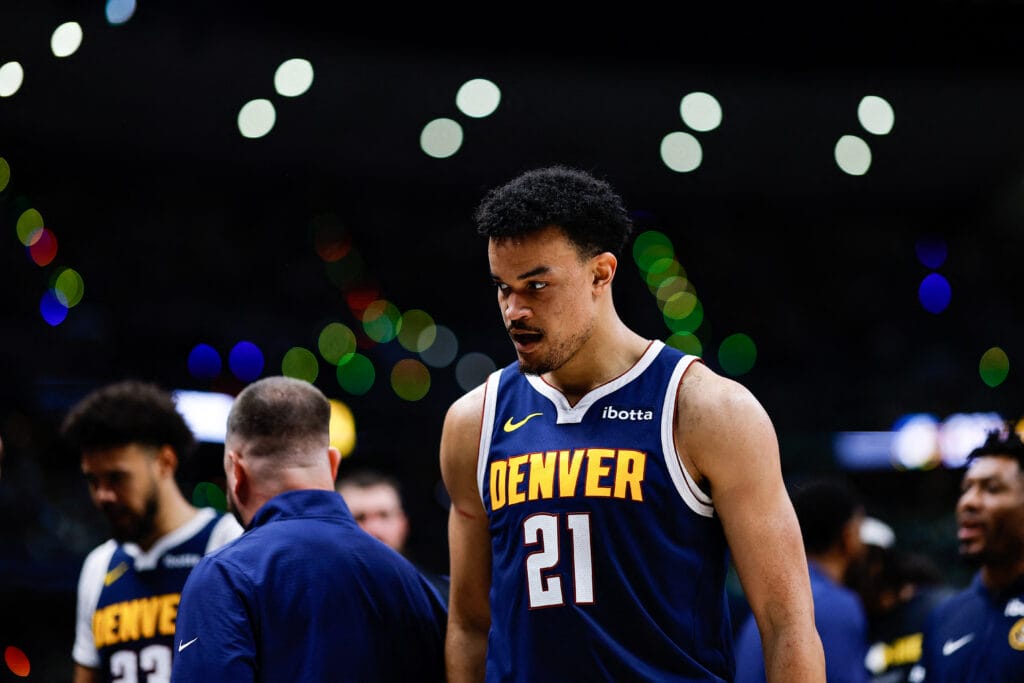
Spencer Jones bet on himself in restricted free agency, and the gamble paid off when Sam Presti of the Oklahoma City Thunder offered him a 2-year, $12 million contract on Saturday, leaving the Nuggets with less than 48 hours to match the offer, which would push them into the second apron.
Denver beat the deadline on Sunday, agreeing to pay up for the former two-way player who broke into a makeshift starting lineup and, ultimately, the playoff rotation. Jones’ stock rose dramatically throughout the season, and now he’s inked his first major deal as a professional athlete.
We’ve grown numb to the numbers flying around in this league, but for an undrafted two-way player who spends too much time on LinkedIn, this is a remarkable development. Twelve million dollars is life-changing money no matter how you slice it, tax it, or podcast about it.
Jones earned David Adelman’s trust as an impact defender willing to lead with physicality — that last bit led to some jokes at Jones’ expense, if not outright frustration over the rate at which he fouls. But I don’t think Adelman ever really minded that dynamic. It all flowed from Jones’ willingness to play defense in the same style as, ironically, his almost-teammates in Oklahoma.
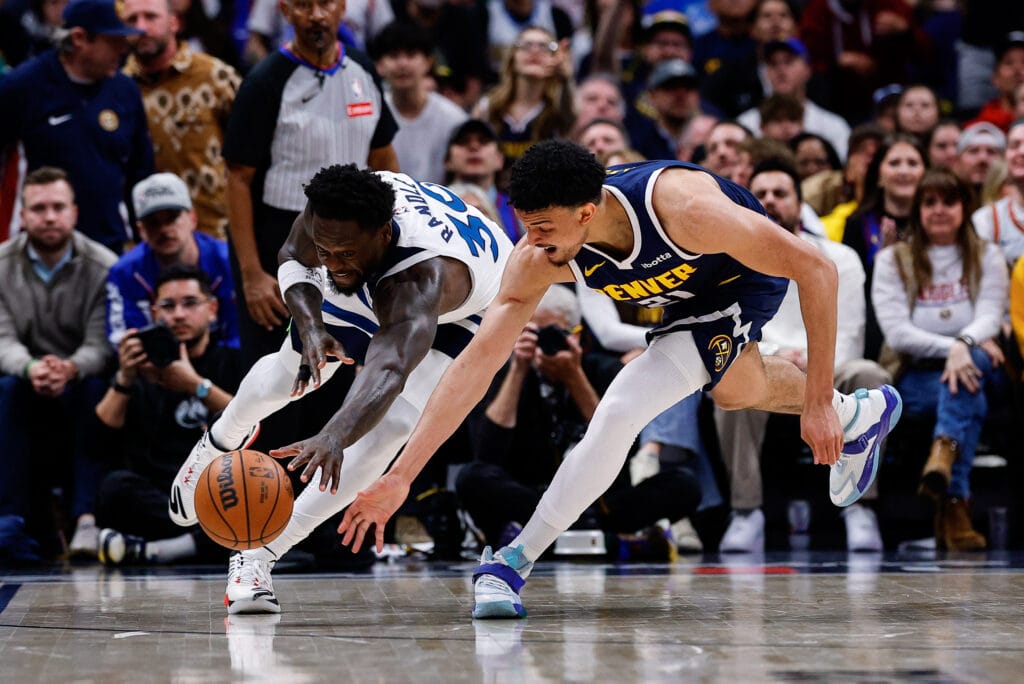
Jones also proved to be a capable corner shooter, demonstrating that you can’t judge a book by its cover, nor a shooter by their form. He shoots like he needs a hip replacement, but the ball goes in the bucket, and the points count all the same.
Jones also showed his composure in the postseason, where he showed he’s playable, and shined in Game 5 of the opening round against the Minnesota Timberwolves. He dropped 20 points in an elimination game while shooting 4-of-5 from 3-point range.
For the Nuggets, a team lacking capable defenders with an aging core, signing Jones to a reasonable deal seems like a no-brainer. But it was, of course, somewhat complicated by the second apron and their bloated cap sheet.
If factoring in Peyton Watson’s qualifying offer, the Nuggets are now well above that dreaded apron, and looking at a hefty tax bill at the end of the season.
Through this lens, some have taken the perspective that this is a stroke of genius from Presti. A move designed to choke the remaining life out of Denver’s moribund offseason. But that view doesn’t hold up in the context of Denver’s big picture.
They were always heading for a scenario in which they either start the season above the second apron or duck it by offloading a major salary, like Cam Johnson, Aaron Gordon, Christian Braun, or through a sign-and-trade of Peyton Watson. In that sense, the big picture remains unchanged.
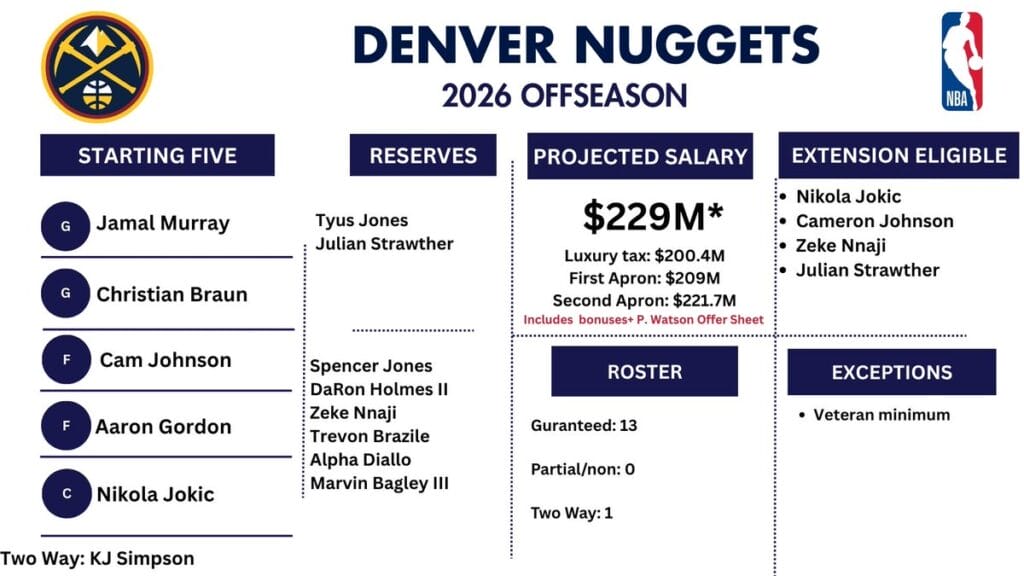
There are some noteworthy implications: as a team that’s now in the second apron, the Nuggets are limited in their sign-and-trade options. They can’t trade Watson for players under contract.
Anyone hoping to land him would also have to help Denver get under the second apron, namely, by moving Zeke Nnaji’s contract — more complicated undoubtedly, though not the worst imaginable outcome for the Nuggets.
If anything, this makes it all the more likely that the Nuggets will either retain Watson on a team-friendly deal, or he, too, bets on himself by accepting the qualifying offer. The latter option seems unlikely, as Watson would be risking his first major contract amid an epidemic of soft-tissue injuries throughout the league.
If they do extend Watson, the Nuggets will be looking at the most expensive roster in NBA history, barring a major trade. They’d also be the only team above both aprons. The team has signaled through the media that they’re willing to cross that threshold to field a competitive squad, but there’s little precedent to support that ownership will sign off on the largest single-season tax bill in history.
They may well enter the season in such a fashion, and do their best to get out from under it by the deadline. They wouldn’t be negotiating from a place of strength in any such trades, but one could argue that’s already the case.
Regardless of the timeline, they could try to move on from Cam Johnson — but it’d be hard to ignore the asset mismanagement, having traded Michael Porter Jr. and a future first for one season of a player who’s subsequently salary-dumped. But as a good player on an expiring contract, that might be the simplest path to cutting salary.
They could try to move on from Aaron Gordon — but any argument for them as contenders is contingent upon his availability. If he’s not on the roster at all, well. It’s hard to imagine them making a run.
Some may argue that’s best for long-term team building, especially due to his availability, or lack thereof. But it still comes at the cost of a gap year, or “evaluation year,” during Nikola Jokić’s prime, not to mention the cost to the fan base, who have embraced and celebrated Gordon as a local hero.
They could try to trade Braun, and I’m sure they’d like to after a brutal season featuring a significant injury. But on year one of his new deal, and after some lowlights in the postseason, it’s hard even to imagine a landing spot right now. Plus, they’d be left with a glut of power forwards and very few gaurds.
Either a big decision is coming between now and the trade deadline, or an even bigger tax bill is on the way. In either case, the Nuggets couldn’t afford to let a quality, affordable role player walk out the door. And they made a competitive move in matching OKC’s offer sheet.
Spencer Jones is worth the 12 million, and this financial hellscape was coming either way.