


The NBA continues screeching towards its postseason, now just a couple weeks away, and we’ve seen some glorious basketball in the past week that tease what some of the best postseason matchups should look like, including the Denver Nuggets’ overtime win over the San Antonio Spurs, a brilliant display that we’re poised to see in the second round should the standings hold and both teams advance past their opening opponent.
In this trends piece, we’re noting a few of the latest graphs from our excellent ALLCITY NBA producer Atticus O’Brien-Pappalardo, rehoming them to the site in case you missed them on social media, with further observations on each.
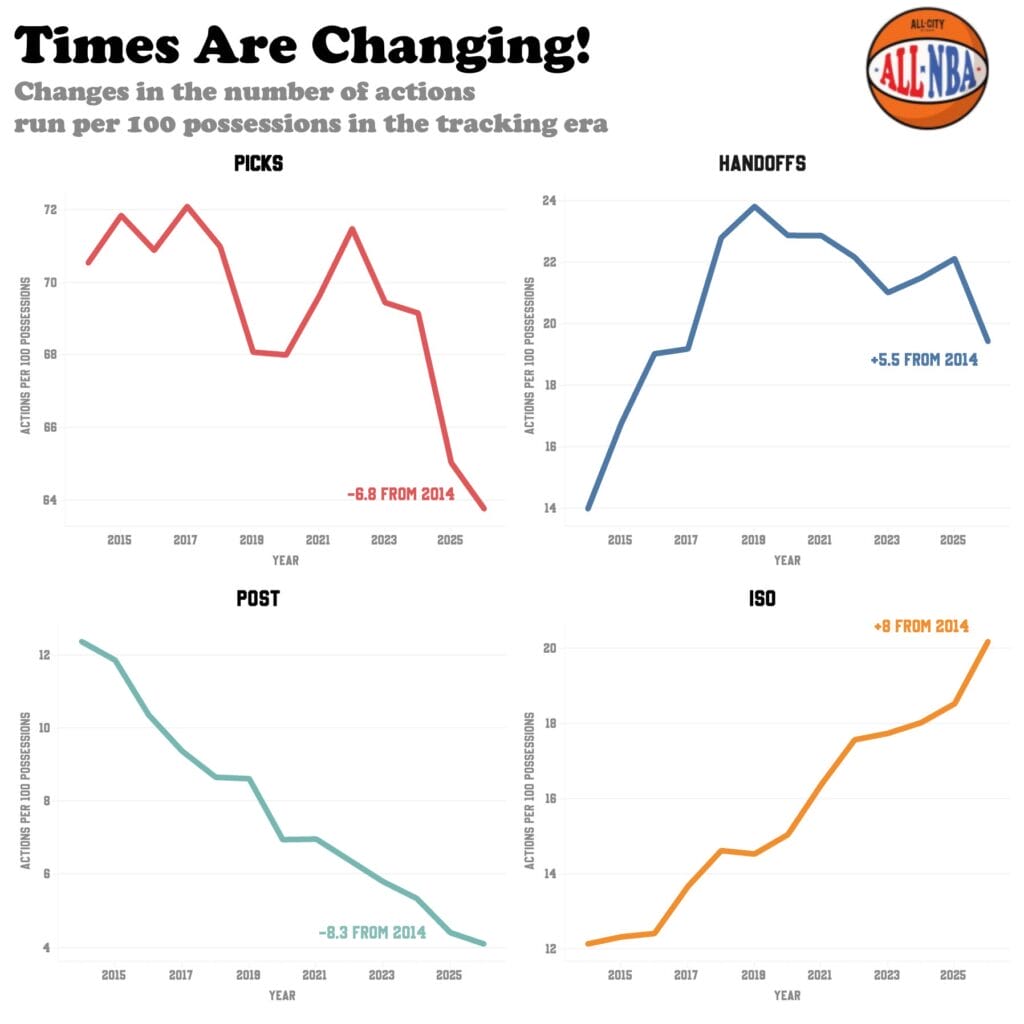
- The NBA still revolves around the pick-and-roll. Note the y-axis on that chart compared to the others: The pick-and-roll has declined, but teams still average well over 60 such possessions per game. It’s the action that teams have always used to test an opponent’s schemes and interconnectivity. It’s why, schematically, if you could name any defensive coverage, it’s probably “drop coverage” or “switching”, an area where basketball discourse has done the best job emulating how the NFL discusses its intricacies.
- How defenses guard pick-and-rolls often creates an offense’s tendencies: For example, the James Harden-led Houston Rockets would’ve happily ran pick-and-roll basketball every possession of every game, and they tried. Harden was too good at manipulating those pick-and-rolls in a five-out spread offense that teams finally came to the collective understanding that switching them, leaving him to hunt a mismatched big man or smaller defender, was the best outcome. As the 3-point era led to better shooters and spacing, isolation basketball was already becoming more appealing. Those defensive choices, for teams like those Rockets, were the ones that chose their own strategy. It was formula-fed decision making … and they nearly beat the best team we’ve ever seen while doing it.
- We’ve never before seen this much switching in the NBA as a pick-and-roll coverage, literally, as the chart below shows:
| SEASON | SWITCH % |
| 25-26 | 25.9% |
| 24-25 | 24.6% |
| 23-24 | 22.5% |
| 22-23 | 23.9% |
| 21-22 | 23.1% |
| 20-21 | 18.5% |
| 19-20 | 16.3% |
| 18-19 | 15.9% |
| 17-18 | 15.9% |
| 16-17 | 13.0% |
| 15-16 | 10.3% |
| 14-15 | 7.9% |
| 13-14 | 7.1% |
- When the 2013-14 Dallas Mavericks nearly beat the San Antonio Spurs in the first round, taking them to a Game 7 and challenging them more than they were in the subsequent three series they won to become the 2014 champions, it was the first instance we’ve ever seen of a switch-everything tactic being deployed for an entire series. Rick Carlisle chose to push San Antonio away from its Beautiful Game style by having every defender switch their pick-and-rolls, slowing down the rhythmic pick-and-roll-and-ball-movement-for-the-open-shot even if it meant Tony Parker might cook Samuel Dalembert or a mid-30s Dirk Nowitzki on the perimeter several times per game. (That’s why DeJuan Blair became so important in that series; he was an early archetype of the switchable big man we see today.)
- More switches means more isolations, like in Harden’s case, but it also means more post-ups, something we’ve seen from players like Kristaps Porziņģis when the Boston Celtics won the 2024 title. However, post-ups have nearly died out as a proactive offensive choice — there are of course exceptions, most notably the Denver Nuggets — and much more closely align as a reactive one for teams to attack switching defenses.
- Likewise, handoffs have skied in part because those are actions much harder to switch. Every offense still wants to run pick-and-rolls, and an opponent switching their preferred combinations comes from the belief that their offense would be worse if it had to rely on isolation basketball. These offensive teams often accept that … but not without any resistance. The designated handoff became one of the preferred means of resistance, a pick-and-roll you can spring more quickly and less predictably to the opponent.
- Basketball’s in a good place, and we’ll see it evolve in other ways over the next decade that’s coming.
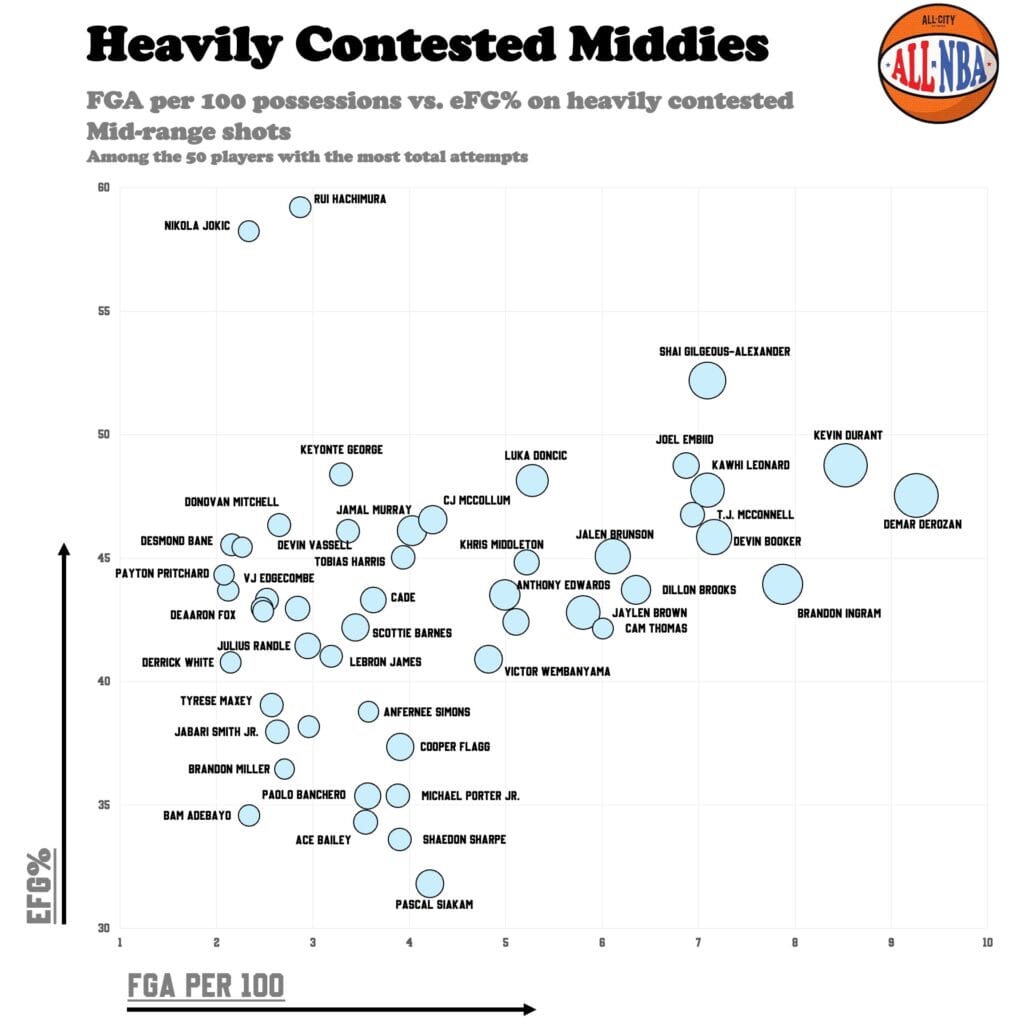
- Nikola Jokić and Shai Gilgeous-Alexander are absurd men. Jokić obviously doesn’t rely on his mid-range jumper like Gilgeous-Alexander, but we saw him hit necessary 2s in that overtime win and potential playoff preview against San Antonio. It’s nutty he’s having the second-most efficient season of his career. And Gilgeous-Alexander, the other best player in the league, just completely outdoes nearly the entire league by quantity while still shooting better than anyone not named Jokić. And Rui Hachimura, too, of course. You can never forget Rui.
- VJ Edgecombe doesn’t have a huge circle, but he’s in good company on the chart’s central left side, hanging out around players like Desmond Bane and Payton Pritchard, which is a wonderful place to be. He’s shooting mid-rangers better than De’Aaron Fox has this season, in fact, and that’s my main concern about the Spurs in this postseason: Do they have high-end ball handlers who can create isolation looks when needed? For example, such as when teams switch everything?
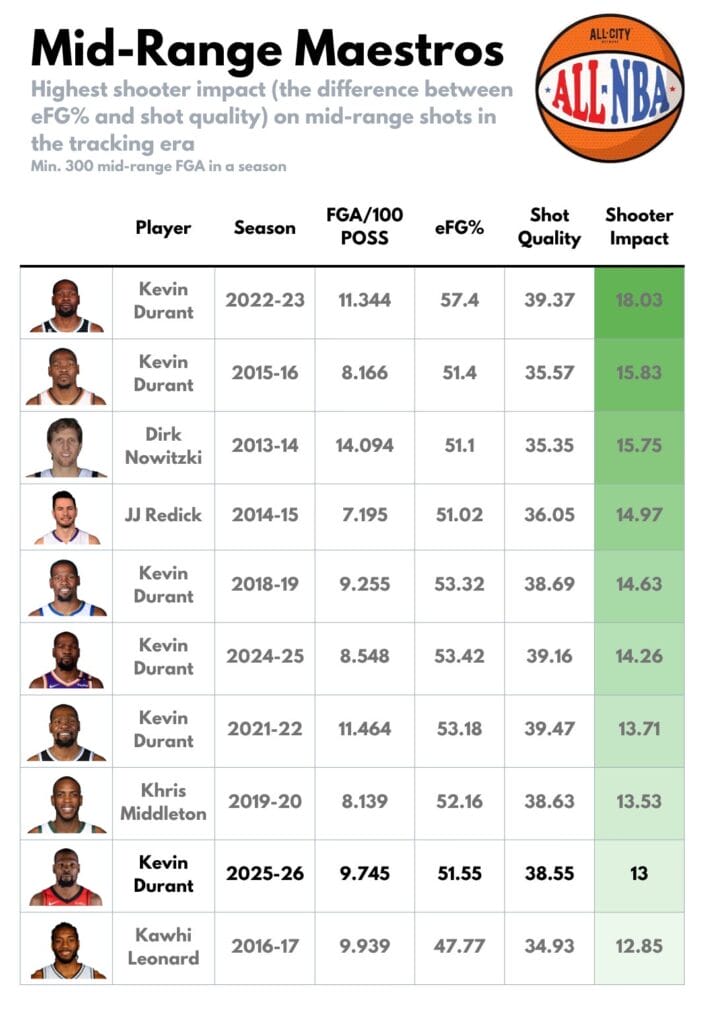
- The other mid-range god up on the first chart, as seen in this one, is Kevin Durant, who’s still doing this thing he does better than anyone else ever has: Make more of the most difficult contested pull-up 2s you have ever seen in your life.
- If the graphic’s unclear, shot quality is a Second Spectrum metric that, like the expected goals metric in soccer, suggests what an average NBA player taking those same shots would shoot on them. (Because we’re dealing with 2-pointers, effective field goal percentage (eFG%) is the same as field goal percentage. Basically, this season, when tallying up all of Kevin Durant’s mid-range 2s, the model suggests the most average shooter would hit 38.6 percent of them. Durant has hit nearly 52 percent. We’ve never seen a better pure scorer, I don’t think.
Tim Cato is ALLCITY’s national NBA writer currently based in Dallas. He can be reached at tcato@alldlls.com or on X at @tim_cato.