


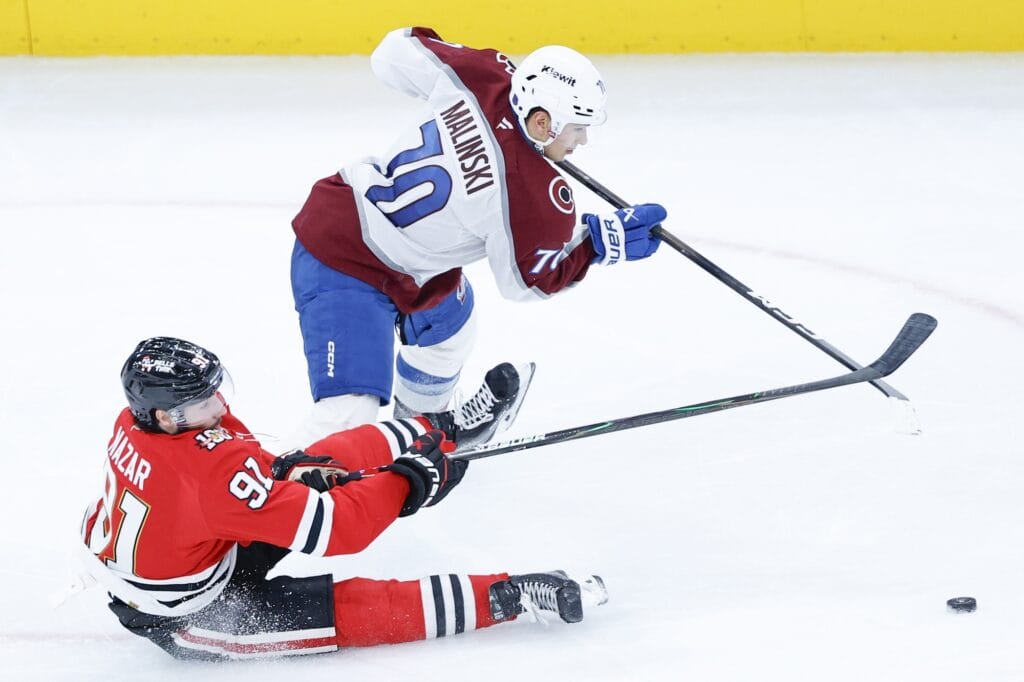
The Colorado Avalanche announced today that they have signed defenseman Sam Malinski to a four-year, $19M ($4.75M AAV) extension. The deal removes the 27-year-old from the free agent market this summer and locks down a player enjoying a significant breakout season for the Avalanche.
Malinski gets good security from this deal as he gets a full no-trade clause in the first two years before it becomes a 10-team no-trade clause in Year 3 and goes to a 6-team no-trade clause in Year 4. He makes $5.5M in base salary next year and then $4.5M in base salary in Years 2 and 3, which drops to $3.5M in base salary in Year 4. He also has a $1M signing bonus in Year 4 that will be owed to him on July 1, 2029.
A late-bloomer who signed as an undrafted free agent out of Cornell University in the spring of 2023, Malinski showed well in the AHL with the Colorado Eagles while getting a 23-game cup of coffee (is that more like a jug of coffee?) with the Avalanche in 2023-24.
From there, Malinski has spent the last two seasons in the NHL with the Avalanche. As a right-shot, puck-moving defenseman, Malinski’s skillset has always been a bit redundant in Denver, especially on the smaller side at 5’11”, 190 pounds, but he’s made it work.
Last year was fine, but 15 points (5G, 10A) in 76 games betrayed the puck-moving reputation a bit and set him up for this season. Let’s get into that.
Malinski has been a stud for the Avs this year
You know I’m going to do it, so let’s just talk fancystats. Let’s start with his player card, the easiest of them to digest and understand.
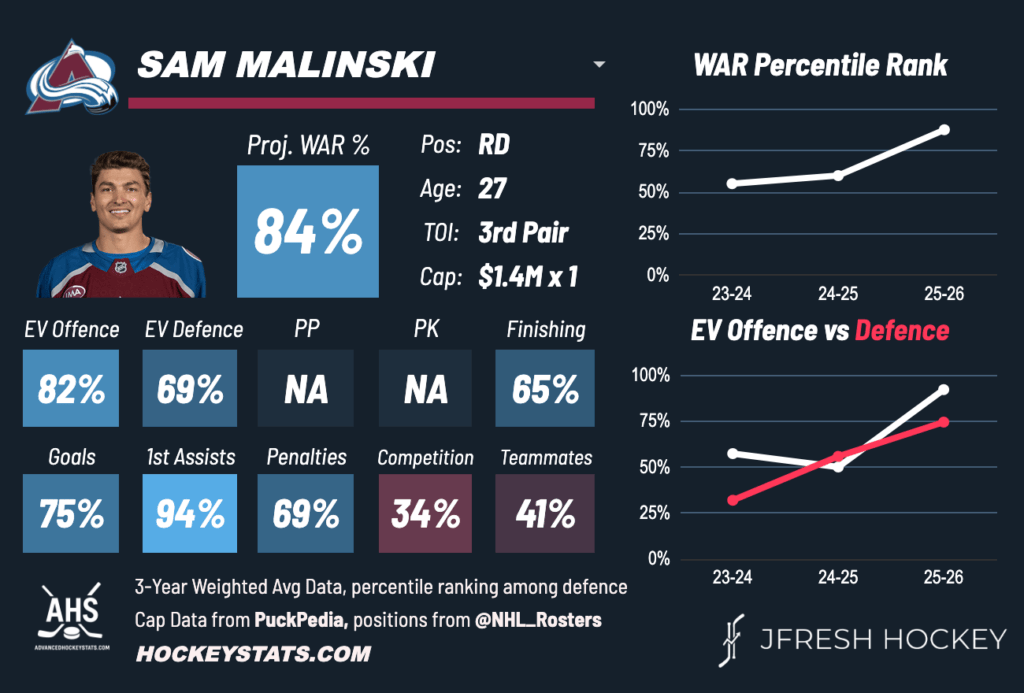
This shows Malinski is driving offense at a higher rate, defending at a higher level, and producing offense much better than last year. On that last point, he has smashed last year’s point total (15) with 24 points (3G, 21A) through 50 games. Another model also shows a player who is playing on the right side of the puck more often than not.
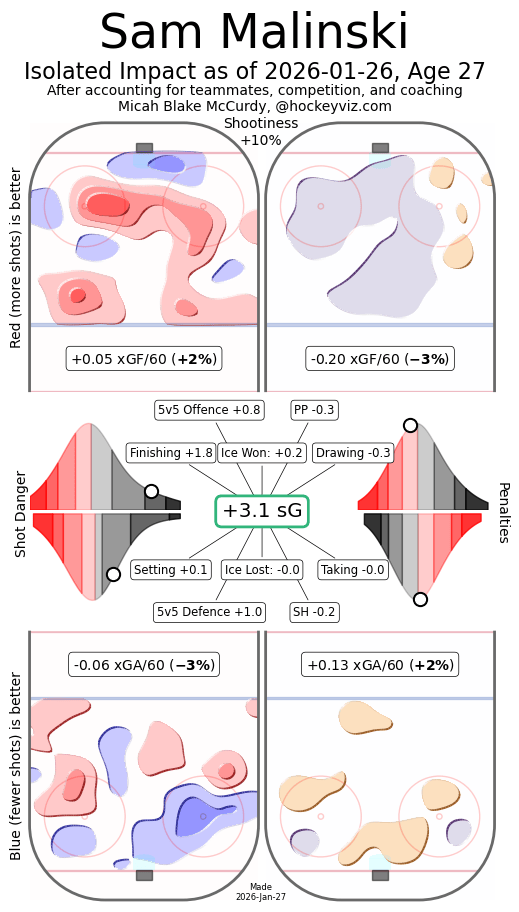
What this does show is that Malinski hasn’t been effective on either special team unit, but he’s played only 6:38 on the power play and 33:39 on the penalty kill. Personally, I’d like to see him on the second power play unit a bit more, but the only reason he should be on the PK is if the game is out of hand on the scoreboard or something has gone wrong with injuries and players in the penalty box.
If we look at Malinski’s microstats, we still see an effective player.
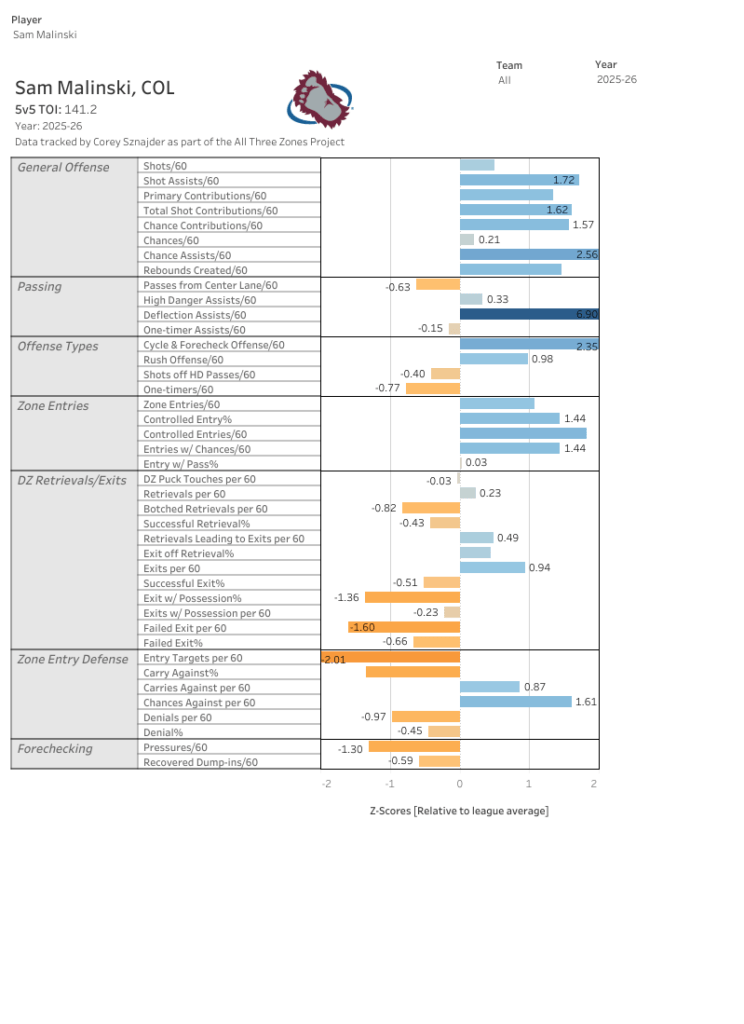
These numbers are almost entirely based on what a player does with the puck, and we see that he has lived up to his reputation as a puck mover without any real complaints so far this season. This has been a boon for the Avalanche as Malinski has improved the offense they get from the non-Makar minutes, something they certainly needed a boost in this season.
Of the 175 defensemen who have played 500 minutes at 5v5 this season, Malinski is seventh in points-per-60, which is a number that showcases scoring ability in the role they are in. If you’re curious, Makar is third on that list, Brent Burns is fifth, and Josh Manson is 10th, so the Avs are pretty good in this area. Malinski is the only one of those players making less than a million dollars this year, however, and is a big reason why he will be making just under $5M for the next four seasons.
While this success is great, there is important context to consider here. If you look up at the first player card, you’ll see that his “competition” is just 34%, meaning he has played a sheltered role this season. He isn’t exactly facing top competition on a nightly basis, but the level of his success does suggest he might be able to handle a more prominent role moving forward.
Manson is signed for next season, but Burns is not. While the Avs are in the unique spot this year of having too many right-handed defensemen, that may not be the case next year. Malinski’s breakout and age are all positive indicators that he could be a strong contributor for years to come. While Burns has performed solidly given his age (he turns 41 in March), Malinski is a safer bet to perform much of the same job over the next four years.
It is also to be considered that the Avalanche are now paying Malinski to be more than a third-pairing player beginning next season. $4.75M may not be high-end money, but it isn’t the kind of cash you hand over to a player who you are expecting limited contributions from, either.
What does this mean for next year’s salary cap situation?
Coming into the season, the Avs actually had plenty of cap space to play with next summer. After re-signing Martin Necas, Scott Wedgewood, and now Malinski, that cap space has been largely eaten up.
Even with the large jump in the cap next season, the Avs are already down to $8M left in salary cap space, which is a touch deceiving because Burns has up to $4M in potential bonuses that could eat into that. $3M of those bonuses already vested, so the Avs either have to find room this season for that $3M to hit, or carry it over against next year’s cap.
The likeliest scenario has always been carrying it over, and the last $1M bonus comes only if Burns averages more than 23 minutes per game. He’s averaging just 19:25 right now, so there’s no realistic threat of this bonus hitting.
Some napkin math suggests carrying the $3M over into next season, with $8M in space, which leaves the Avalanche with $5M remaining. The remaining unsigned players roster regulars are Burns (UFA), Jack Drury (RFA), Victor Olofsson (UFA), Joel Kiviranta (UFA), and Zakhar Bardakov (RFA). This signing signals to me that Burns is unlikely to return next year, but that certainly isn’t set in stone. Drury is due a decent raise from his current $1.725M salary, Olofsson seems unlikely to return (Gavin Brindley is on hand to do that job), and Kiviranta would be a good bet to take another cheap one-year contract to return, or the Avs replace him with a similarly-priced player.
That isn’t much wiggle room, which brings us to two players who have spent a lot of time being talked about as possible trade fodder: Sam Girard and Ross Colton. Both players would seem to be at the nadir of their trade value, with each currently having down years (Colton’s five-goal season is hurting all parties), but they make $5M and $4M, respectively.
You can understand where they would become obvious candidates to be moved, as they are among the few players not providing obvious surplus value to the team relative to their contract. This is especially true of Girard because Malinski came in and has effectively outplayed Girard in the same role and the reality is that the Avalanche cannot go into the postseason with a defense this small.
They need a stylistic balance somewhere; it was Malinski back in October, but based on their play and Malinski’s new contract, Girard is now firmly in the crosshairs as the odd man out. Getting a bigger left-shot defenseman who can eat some valuable minutes and handle some of the more defensive duties while not being a complete black hole offensively is high on Colorado’s trade deadline to-do list.
The obvious problem with moving Girard is that they need to replace him on the left side. Would a team be interested in a stylistic swap of a stout defensive defenseman for a puck-moving type? With the way teams obsess over size and toughness, I am curious if that deal is on the table. The Avs have scoured the lands far and wide for this type of player, and so far, their only answer has been Ilya Solovyov, whom they moved in a trade last week.
It’s going to be another fascinating trade deadline for Avalanche general manager Chris MacFarland and the Avalanche. Today’s signing of Malinski would seem to serve as the first meaningful move as they keep an impact player who has fit them wonderfully while providing a more reliable two-way presence than teams normally get from third-pairing defensemen. Given this cap situation, he may not be a third-pairing defenseman much longer.

1 Comment
RockD
Just waiting to see who drops completely out of contention so they can find a trade partner. Maybe the Rangers will look for a puck mover but their pickins are slim on the blue line with Sousy already gone. I still think Oleksiak has the look of the “new Jack Johnson”