


This week, we’re looking into the most electric two-man game you’ve never heard of, the league’s most brazen shooter who correctly believes he’s always open, another shooter who just set the league’s most niche record, and how a New Zealander’s injury alters one Western Conference team’s promising season.
PHOENIX’S GOT STEPH AND DRAYMOND AT HOME
The Phoenix Suns’ success, more surprising than any team in the league, can’t be limited to any one thing. It comes from the team’s defensive harassment, from this summer’s bargain bin finds providing more value than the money they’re still paying Bradley Beal, from the synergistic identity between Phoenix’s mid-range prowess and its aggressive crashing of the offensive glass, from the first-time coaching staff that instilled that, from the roster’s 3-point temerity. It only now re-includes Jalen Green, who returned earlier this week from an injury that had limited him to just two games this season. How he changes the team’s offensive process is a fascination.
The two-man game between Collin Gillespie and Oso Ighodaro, however, deserves some specific applause. The 26-year-old Gillespie has already played more minutes than his first two seasons combined, starting the past 23 games, thanks to a shameless shooting trigger and handsy defending. Ighodaro, a mid-second-round selection last summer, has firmly grasped the coaching staff’s trust to be the team’s backup center who will switch onto anyone and always knows where to swing the next pass. When working together, most often in semi-transition moments or on the court’s weak side, those two have revealed a shared hive mind for creating good shots. Just look at this play, as highlighted by the excellent Suns podcaster Mike Vigil, who noted one example of what we’ve seen from this duo all year.
Gillespie and Ighodaro have combined for 66 assist opportunities between each other this season: Gillespie feeding Ighodaro for 22 assisted buckets, Ighodaro returning the favor for another 17 back to him. That’s a combined 39-of-63 shooting (61.9 percent) when directly shooting off the other’s pass, including 11 triples made by Gillespie, who’s tied for the team’s most made 3s this season.
It’s instinctive read-and-react basketball involving two players deeply aware what Gillespie’s movement does to opponents, which works even better because of the spontaneity of their two-man game. Because Ighodaro doesn’t shoot, his defender often sags into the paint whenever he’s away from the ball. If Gillespie’s pick-and-rolls with him were primary actions, it’d be predictable, giving Ighodaro’s defender time to recover to the point of the screen. But, too often, defenses find themselves in a blender when this two-man game appears away from their focus. Ighodaro’s man, hustling back too late to deal with the two-on-one they unexpectedly created, is often victimized. Just watch these 40 seconds of them playing off each other.
It’s also how they pass: not to each other, but to the shot they expect the other player to take. Gillespie leans around defenders to throw bullet passes and hits him with leading one-bouncers when the lane’s open for the roll. Ighodaro often flicks these tosses back to his teammate, sometimes hardly looking, making these plays far less anticipatory than the more traditional dribble handoff. It does evoke a discount version of Stephen Curry and Draymond Green’s, whose two-man process has long been the league’s best.
Gillespie and Ighodaro have only played 503 minutes together this season, less than a quarter of the team’s minutes. That’s fine, of course. Ighodaro’s minutes have risen slightly over the past two months, even occasionally closing games, but he’ll remain second-string to Mark Williams. Due to those built-in minute limitations and the inherently reactionary nature of this two-man game, these two won’t come anywhere near the league’s most prolific twosomes seen below.
| BEST DUOS | FGA | eFG% |
| Murray + Jokić | 230 | 71.5% |
| Avdija + Camara | 204 | 52.7% |
| Curry + Green | 190 | 63.7% |
| Johnson + Alexander-Walker | 187 | 77.0% |
| DiVincenzo + Randle | 175 | 56.3% |
Compared to these duos, the Gillespie-Ighodaro connection is just a sideshow. But that’s exactly what it’s intended to be, a weapon most often sprung on opponents when they’re worried about everything else. It’s no surprise, then, that the Suns have outscored opponents by almost 15 points per 100 possessions whenever Gillespie and Ighodaro share the court this season. That’s largely because Gillespie and Ighodaro, independent of each other, are good players constantly making winning plays. But that’s never more obvious than when they team up together with one shared brain to create wide-open looks.
MICHAEL PORTER JR. DOESN’T CARE IF HE’S GUARDED
We’ll find out next week if Michael Porter Jr. is an All-Star, but he should be. The 6’10 Brooklyn Nets forward has been the league’s most audacious shooter not named Curry this season, a walking heat check who fires up shots with utter disregard for defenders around him. I’m convinced Porter would still launch from 30 feet if his defender was a surface-to-air missile battery. Here are two of his brashest attempts:
Porter has earned this green light. He’s scoring 25.3 points, his career best, and averaging 3.8 made 3s per game. When behind the arc, he’s shooting 39.6 percent overall, 41.6 percent on catch-and-shoot looks, and 44.8 percent when wide open. He barely gets those last ones, the wide-open looks, averaging fewer than one per game. Brooklyn, the league’s fifth-worst offense, doesn’t often generate them for their star player who attracts every opponent’s most attentive eye. So Porter, this season, has stopped worrying about how open he is or isn’t. He just shoots, no matter the contest level or difficulty, which turns out is high. The highest in the NBA, in fact, and it’s not particularly close.
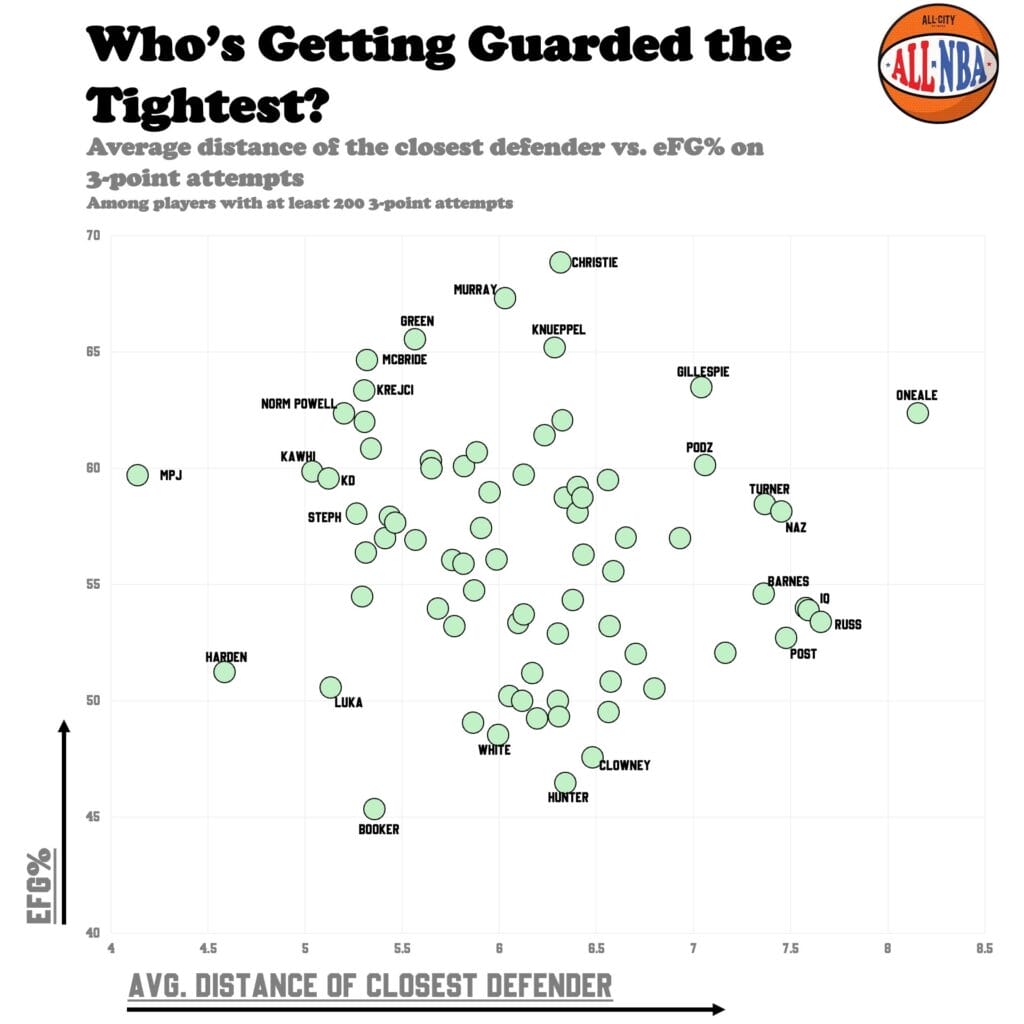
When Porter shoots 3s this season, he knows there will be a defender, on average, within 4.1 feet of him. Only one other player, James Harden, comes close to that number. (His 3s have had an average defender distance of 4.6 feet.) For the rest of the league, that stat starts at five feet. For context, some of the league’s most trigger-shy shooters might see an average defender distance of eight or nine feet. Which is to say, as seen in the chart above: Porter hasn’t just taken the league’s most difficult 3s; what he’s doing is an outlandish outlier even compared to the league’s best shooters.
Since the tracking era began in 2013, only two players have had seasons taking 3s more heavily contested than Porter’s this year: Kobe Bryant in the 2014-15 season; James Harden’s 2018-19 campaign. Per that same tracking data, Bryant overperformed his expected field goal percentage on those shots, which was 41.4 percent, by about 2.5 percent. Harden outdid his expected conversion rate by nearly nine percent. If an average player took the same 3s as Porter, Second Spectrum’s model believes they would have an expected field goal percentage of 46.2. Instead, Porter’s actual figure is 59.4 percent. It’s the 12th-highest overperformance in the tracking era.
Porter’s season, it’s not at all hyperbolic to say, has been one of the greatest shooting seasons this league has ever seen.
THE NEW “MAX HOOPER” CROWN GOES TO…
Max Hooper owns what might be college basketball’s least touchable record: A decade ago, during his senior season at Oakland, Hooper attempted 257 3s without taking a single 2. That’s correct: In 35 games, playing 862 minutes, Hooper never took a layup, never even launched a 3 with a foot on the line. He finished his four-year college career with 479 attempted 3s — making more than 42 percent — to just 11 attempts inside the arc.
After a couple seasons barely playing in the G-League, Hooper turned to coaching; he’s currently the head coach for the Texas Legends. But Hooper’s spirit lives on in the NBA thanks to Sam Hauser, who recently became the league’s new holder of the Max Hooper crown, which we are bestowing upon the player who attempted the most 3-pointers in a game without a 2.
In the Boston Celtics’ blowout win against the Atlanta Hawks this past weekend, Hauser took 21 shots in 30 minutes. All 21 attempts were from 3, shattering what had been a three-way tie for the record of 17. One of those players, Julian Champagnie, had joined this record just weeks before. He hardly even had the chance to enjoy his crown before Hauser snatched it.
| DATE | PLAYER | 3PA | 3PM | 2PA |
| 1/17/2026 | Sam Hauser | 21 | 10 | 0 |
| 12/31/2025 | Julian Champagnie | 17 | 11 | 0 |
| 3/9/2022 | Malik Beasley | 17 | 11 | 0 |
| 4/5/2015 | J.R. Smith | 17 | 8 | 0 |
| 11/4/2021 | Duncan Robinson | 17 | 5 | 0 |
| 4/13/2025 | Lindy Waters III | 16 | 6 | 0 |
| 11/10/2025 | Sam Merrill | 16 | 4 | 0 |
| 11/20/2019 | Duncan Robinson | 15 | 9 | 0 |
| 3/8/2020 | Dāvis Bertāns | 15 | 8 | 0 |
| 2/9/2020 | Duncan Robinson | 15 | 6 | 0 |
| 1/16/2019 | Gerald Green | 15 | 5 | 0 |
Hauser became the 18th player to attempt 20-plus 3s; his game was the 35th instance in NBA history. Unsurprisingly, Stephen Curry has the most such games with 10. But while Curry is this sport’s greatest shooter, he isn’t a worthy successor to Max Hooper. In all 10 of those games, Curry, unfortunately, couldn’t resist the allure of the 2. Hauser did, and the crown is now his alone.
For what it’s worth, Hauser isn’t quite the league’s most exclusive 3-point-taker. This season, that’s Nicolas Batum, who has taken 95 percent of his shots behind the arc. Hauser, in contrast, only succeeds in taking 88 percent of his attempts from distance. He’s even had a couple games this year where, disgustingly, he dared to shoot three(!) times inside the arc. We’ll do our best to ignore that at the crowning ceremony.
HOW STEVEN ADAMS’ INJURY CHANGES HOUSTON
Steven Adams suffered a grade-three ankle sprain this past weekend, and the team has said he’s out indefinitely. Jeff Stotts, the league’s premier expert on injury absences, has said that grade-three sprains cost players an average of 63 games. Adams will be out at least past the All-Star break and perhaps most of the regular season, too.
It’s bad news for the Rockets’ sometimes clunky offense, which has heavily relied on Adams’ ability to generate second chances. Adams, the league’s most talented getter of his own team’s missed shots, has led Houston to its first place rank in offensive rebounding percentage (39.7 percent), which other teams can’t even come close to matching. (The difference between Houston and No. 2-ranked Detroit, at 34.8 percent, is the same as the difference between Detroit and the league’s No. 11-ranked team.) When Adams is on the court, Houston grabs an unbelievable 44.3 percent of its own misses, basically ensuring almost every other missed shot earns a mulligan. Crucially, Adams is the player who makes sure that his team’s offense isn’t reliant on making jumpers. Houston takes the fewest number of 3s during his minutes, with just 31.3 percent of their field goals coming behind the arc when he’s playing. Adams’ vacuuming in the painted area makes 3s unnecessary.
Unfortunately, now facing his extended absence, the Rockets will need to make more jumpers again. That’s not great:
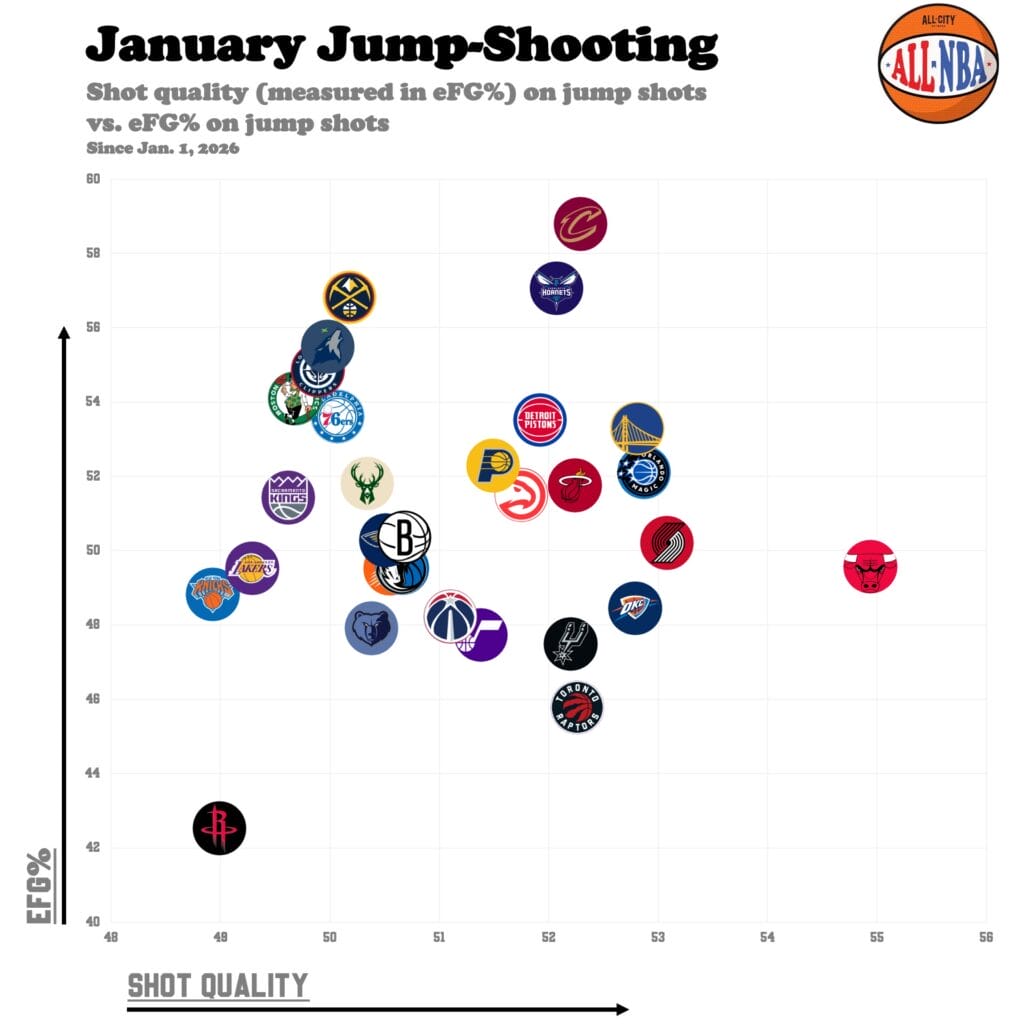
That graphic, published on Monday, doesn’t include Houston’s last game, a win against the San Antonio Spurs, which featured Reed Sheppard coming off the bench to nail four 3s and lead his team with 21 points. The Rockets remain the league’s worst 3-point-shooting team this month, converting fewer than 30 percent of them, and they still average the second-fewest 3-point attempts for the season. Sheppard has had an up-and-down season, more good than bad, which we’ll have to break down soon. (I find him to be a fascinating case study.) In Adams’ extended absence, however, it’s painfully clear the Rockets will need to knock down more jump shots, which might mean empowering Sheppard with more minutes to be that special shooter he’s shown himself to be.
Tim Cato is ALLCITY’s national NBA writer currently based in Dallas. He can be reached at tcato@alldlls.com or on X at @tim_cato.