


Do the Avalanche finally have depth scoring?
After a season in which a three-headed monster featuring Gabe Landeskog, Nathan MacKinnon, and Mikko Rantanen ate the majority of Colorado’s minutes, the Avalanche believe they may finally have consistent production beyond the top line.
As the undisputed second-line center, Nazem Kadri will drive offense alongside Colorado’s budding young forwards. The Avs are hoping he’ll help Tyson Jost and J.T. Compher take strides next year with one on his wing and the other quarterbacking the third line. Joe Sakic acquired Joonas Donskoi and Andre Burakovsky to support breakout seasons for the up-and-comers and add diversity to the forward group.
Burakovsky, however, has arguably just as much to prove as Jost or Compher following two consecutive uninspiring seasons. After a 38-point year in 2015-16, the former first-round pick has since failed to produce at that level. Two identical 25-point seasons (12g, 13a) buried Burakovsky in a third and sometimes fourth-line capacity with the Capitals.
The 24-year-old more or less acquiesced to his limited role, logging just the ninth-best points per minute of all Washington forwards, solidifying him as a bottom-six player. That same production would’ve placed him eighth among Colorado’s forwards.
Burakovsky’s veteran linemates, Brett Connolly (27-years-old) and Lars Eller (30), both had bounce-back seasons last year with little help from the right-handed sniper. Connolly notched a career-high 46 points, while Eller produced 13 goals and 23 assists to finish two points shy of his season record. Burakovsky may have held them back from even better production.
| Player | Brett Connolly | Lars Eller |
| Expected GF% With Burakovsky | 45.42 | 43.22 |
| Expected GF% Without | 53.95 | 58.01 |
| Burakovsky Expected GF% Without | 47.56 | 50.69 |
| High Danger Scoring Chance% With Burakovsky | 41.3 | 40.25 |
| High Danger Scoring Chance% Without | 51.45 | 55.56 |
| Burakovsky High Danger Scoring Chance% Without | 46.72 | 49.57 |
Table 1: Data courtesy of Natural Stat Trick. xGF% represents the percentage of the total expected goals that are recorded for a given player’s team while that player is on the ice.
Both Eller and Connolly saw better underlying statistics without Burakovsky than they did with him. Interestingly Burakovsky also improved without his regular linemates, suggesting the three didn’t fit well together, period.
Enter the Colorado Avalanche. Burakovsky’s transitional speed fits perfectly with the young, agile Avs core. Stretch passes from Cale Makar and Sam Girard for clean shooting opportunities in the slot should give the new No.95 plenty of chances to score. Cohesion with his new teammates will be key to earning a contract extension with the burgundy and blue.
Colorado’s front office was likely encouraged by the Swedish winger’s finish to last season. Burakovsky recorded seven goals and nine assists in his last 35 games, a marked improvement from the measly nine points he managed through his first 41.
While he only logged two points (1g, 1a) in the 2019 postseason, the 6’3″ forward again proved he excels in high-pressure situations. After averaging just over nine minutes of ice time through the Capitals’ first six playoff games, he was trusted with 22 minutes in Game 7 against the Hurricanes. In that span, he put up three shots and sniped a top-shelf beauty.
Burakovsky’s thrilling Game 7 performance gave the Avs a good idea of what he can accomplish given more responsibility. His 11 minutes of average ice time last season was a career-low and demonstrated his diminished role in Washington. To put that in the perspective of Avs forwards, Sven Andighetto averaged the same number of minutes.
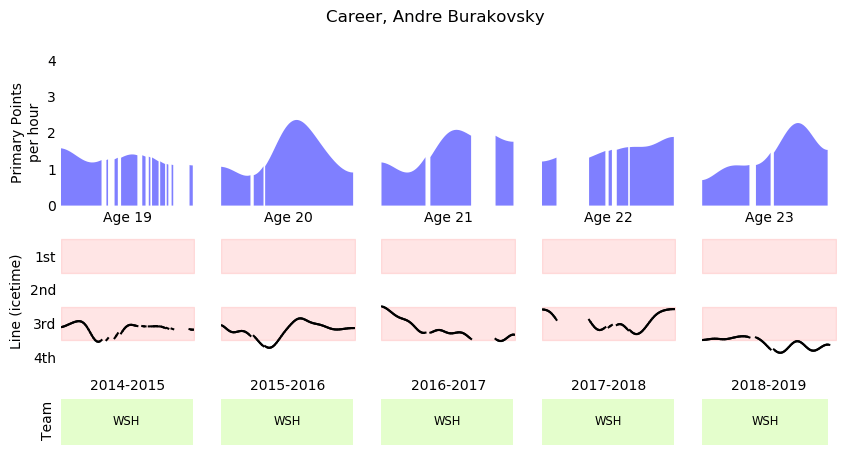
Figure 1: Andre Burakovsky career ice time. Courtesy of Micah Blake McCurdy (@ineffectivemath).
The Avs are hoping a role on their second line and some power-play time will encourage Burakovsky to return to his 2015-16 form.
Assuming he remains healthy throughout the season and logs an estimated 1,312 minutes (16 minutes per game) as a regular second-line player, Burakovsky projects to score 14 goals next year. This number uses his 2018-19 expected goals as an indicator of his ability to score for each minute he’s on the ice. If he plays at the same level he did in 2015-16, however, he projects to score 16.4 goals.
Those totals would have ranked Burakovsky somewhere between fifth and seventh among 2018-19 Avs forwards in goals scored, near J.T. Compher (16 goals) and Alex Kerfoot (15 goals).
Kerfoot bounced up and down the Avalanche lineup last year but eventually found a home for himself in the top-six. While the newly inked Maple Leaf and Burakovsky have different play styles, he will be expected to fill a similar shooting role on the second line. Depending on how he adjusts to top-six duties, Jared Bednar may utilize the former Capital at various roles within the lineup as he did with Kerfoot.
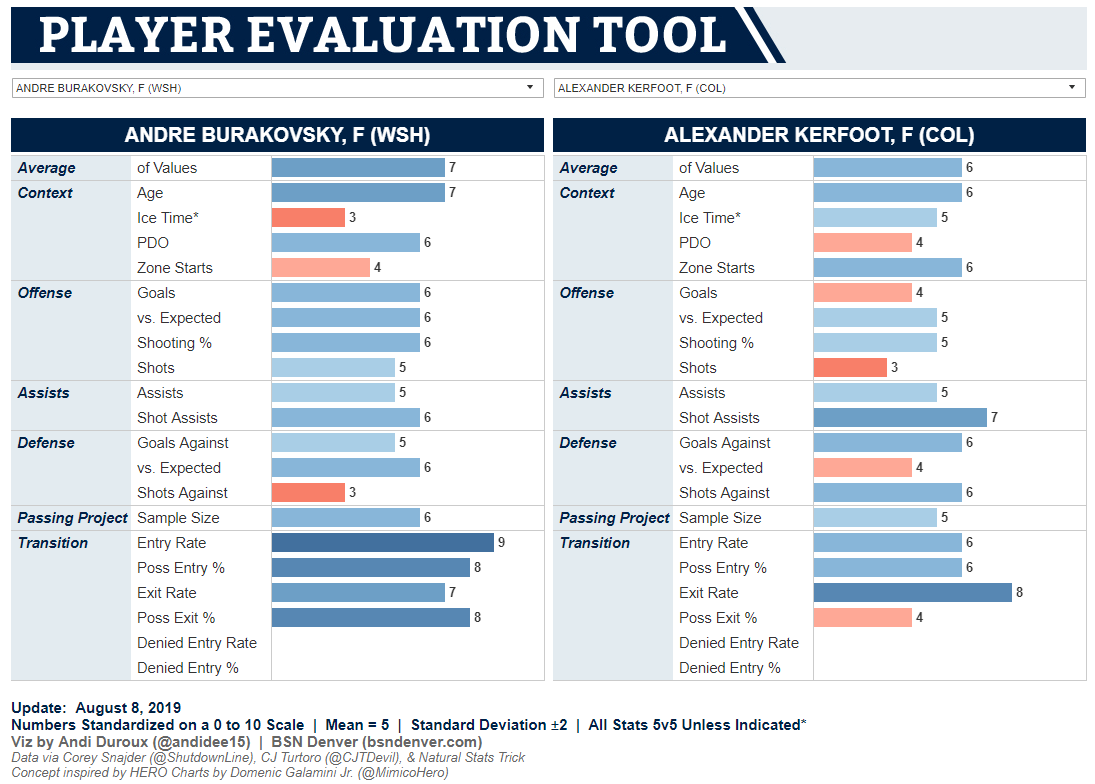
These underlying metrics show that Burakovsky has the potential to replace Kerfoot, and may fit Colorado’s identity better. In transition, Burakovsky’s speed and puck possession promote zone entries. And once he gets in the offensive zone, he’s much more likely to put pucks on net than Kerfoot.
Oh, and did I mention he does all that in a 6’3″, 200-pound frame? His speed and skill are exactly what Joe Sakic has built this young team around, and maybe the towering winger is the missing link.
While there are some serious questions surrounding Burakovsky’s game, he certainly helped the team improve this offseason. Calvert and Nieto were the most frequently used wingers on Colorado’s revolving door of a second line last year (7.18% of even-strength minutes), and the Avs’ offseason moves likely pushed both of them into fourth-line roles.
Despite his upside, a second and third-round pick sure seems like a hefty price for a 25-point player. If his production continues to decline, well, he’s only signed for a year. His $3.25 million trial contract provides the Avs with flexibility regardless of his performance.
The 2018 Stanley Cup Champion is slated to join a line featuring newly acquired Nazem Kadri and, hopefully, an improved Tyson Jost. For a team looking for second-line stability, that sure seems like a group built on a lot of hopes and prayers. But if this line meets its potential, Joe Sakic will again have aced another trade.

0 Comments (5 conversations)
Cerveau
Nice article Luke!
Now… what about Donskoi?
How does he help change the Avalanche equation?
Cerveau
So basically we traded a known quantity (Kerfoot) for an unknown quantity who will hopefully get the same production as the known quantity.
But at least he shoots… which Kerfoot with his Harvard degree couldn’t figure out how to do, so that’s good. Plus he’s big, while Kerf was frequently knocked over and out-muscled by the opponents.
But hey, I really liked Kerfoot.
And hey furthermore, trading Kerfoot helped get us Kadri, who will be a totally obnoxious guy, but heeeyyy… he’s our obnoxious guy.
Luke Marshall
AuthorEverything orbits around Kadri. We have to see if Bura can replace Kerfoot but yeah he’s going to be…interesting to follow next year. His playstyle is very different from Kerfoot’s (see Andi’s graphic) but honestly I like his upside better. It’s the downside that’s hard to wrap my head around. Bura could be just a straight up bust.
Luke Marshall
AuthorListen to today’s Avalanche podcast! He comes up a couple times
Jose
What about Burakovsky’s hand injury? When did it occur and how did it affect his play?
mladen
I would rather they rely on our draft choices like Kaut, Greer etc than bring in players from other teams. The Barrie trade is the exception. They had to trade him and got a decent return.
Eidolon
There’s still a real possibility that Bura doesn’t work out and Kaut gets that job. Greer is not middle-six wing in the NHL, which is the role Bura was brought in to fill. I hope Bura works out. He has the tools and tendencies to be a shoot first option on the 2nd PP and can feed off of playmakers like Jost and Kadri. That wasn’t something that Kerfoot did when they tried him in that role.
mladen
Yeah I agree that Greer is probably a 3rd or 4th liner at this point. I just hated the signing of that 34 year old from Vegas. (Having a senior moment on his name) Greer or another young player should have had that spot. I hope I’m wrong on Donskii(sp), 4 years is way too long.
Busted Twigg
PEB is a center. Greer and Kaut are wings. Kamanev is the guy that is being held back. Greer needs to unseat Nieto or Calvert to get regular NHL shifts.
Luke Marshall
AuthorHe broke both his hands at different times in 2017 and then got surgery on an undisclosed upper-body injury in the 2018 playoffs. It doesn’t seem like his shot has been impacted much but he hasn’t played a full NHL season his entire career
Butters
Prove it contract for bura and not having to pay kerfoot is a net win. Love the confidence in compher