


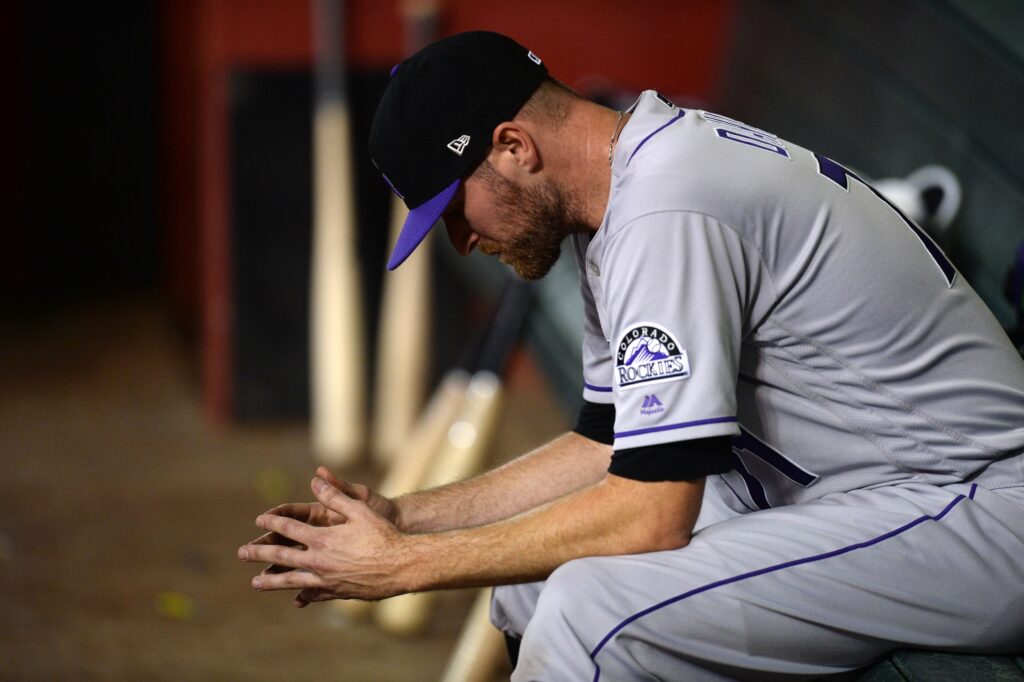
It’s a question on the minds of all Rockies fans following Friday night’s game against the San Diego Padres:
Should you trust your eyes when it comes to closer Wade Davis and his lack of success going back to last year?
Oftentimes in baseball, we have to preach analyzing process over results and implore those who wish to take a more measured approach to the game to avoid reaching conclusions over small sample size data.
In this instance, we have a case where all the evidence is coming together to show that Davis just isn’t the guy he once was.
He’s not the All-Star who dominated late games through the middle part of the last decade. He’s not even the guy who set the Rockies franchise mark for saves in 2018.
There are two primary reasons for this decline: a steady drop in velocity and an increasingly inconsistent ability to locate pitches.
Where’d My Velo Go?
At his peak, Davis’ four-seem fastball averaged over 96 MPH in 2014 and 2015 according to StatCast. He was known to regularly dial up 97-98 MPH when really needing it.
The year before Colorado acquired him, the velo had dropped down to a 94.4 MPH average and his first year in Denver saw a subtle, but further drop to 93.8 MPH. In 2019, when Davis was among the worst relievers in all of baseball, his average fastball fell even more to 93.2 MPH.
So far in 2020, he is sitting at a troubling 91.4 MPH and throughout this period, his cutter has experienced a similar drop from 93.2 MPH to 89.1 MPH.
Since he has always relied on this combo – throwing his four-seemer 47.9 percent of the time and his cutter 25.4 percent of the time, amounting to 73.3 percent of his offerings – the dip in quality of both pitches has had major impact.
Currently, some of the drop in velocity may be attributable to the lack of a typical Spring Training. To be fair, it’s also very early in an otherwise unusual year.
While pitchers tend to round into their best form after several appearances, the pattern is clearly trending in the wrong direction.
The belt-high fastball to Fernando Tatis Jr. with two outs in the ninth that officially blew his first save of 2020 came in at 92 MPH.
Location, Location, Location
Plenty of pitchers in the history of our sport have figured out how to reinvent themselves as age naturally begins to sap the speed of their fastball. This happens when they figure out how to live on the edges of the strike zone and use movement and deception to create outs where once they could use brute force.
Davis has gone the other direction.
As a strikeout-heavy guy throughout his career, he has always had issues keeping the walks down. Again his peak came in 2014 and 2015 with the Royals when he walked 2.88 and 2.67 batters per nine innings, respectively. Other than that though, he hung around in the mid to low threes, including 3.58 in his first year with the Rox.
Oddly enough, that was a marked improvement over his previous year with the Cubs where he posted a then-career-high 4.30 BB/9. He blew that out of the water in 2019 when his command issues came front and center with an eye-popping 6.12 BB/9 rate.
He has already walked three batters in 2.2 IP this season, which is a small sample size BB/9 rate of 10.13.
And it isn’t just the walks.
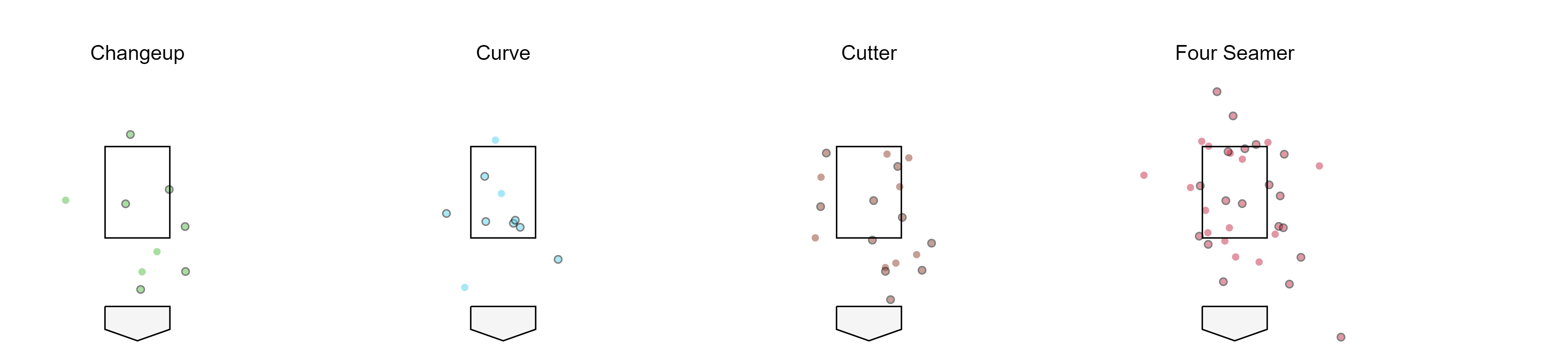
As you can see from these charts of the pitches he has thrown so far this year, also provided by StatCast, Davis is either missing well out of the zone or in remarkably hittable locations.
You can live with that spread on the change-up but the curve isn’t getting beneath the zone, hanging up where it can be hit in the air. The times he has gotten the cutter low it’s been too low to be tempting. And the number of fastballs at the top and middle of the zone, which are much easier to drive in the air, dramatically outweigh the handful on the lower and outer edges.
So in addition to the rising walk rates, his strikeout rate is also staggering off from 10.74 K/9 in 2018 to 8.86 K/9 in 2019 to just one strikeout so far this season.
Trust Your Eyes
The results of steadily declining velocity, climbing walk rates, plummeting strikeout rates, and generally far more pitches winding up in locations that neither the catcher or pitcher wanted?
Davis has seen his Barrel Percent (how often he gets squared up) rise from 4.5 percent in 2018 to 7.5 percent in 2019. In 2020 so far, it sits at a whopping 20 percent.
Davis is failing not as the result of bad luck or being bested by elite hitters making great plays; rather, he’s throwing more and more pitches that are either well out of the zone or in very hittable spots without the electricity they once had.
So, trust your eyes. And trust these numbers.
Davis isn’t who he once was anymore.
That doesn’t necessarily mean he needs to be cut from the roster. There is further data that shows he has been adept at preventing runs out on the road and has done better in non-high-leverage situations even through all these struggles.
Also, with the expanded rosters, there isn’t exactly a desperate need to call up an additional reliever when Colorado has three pitchers in the ‘pen who haven’t even been used yet.
But he shouldn’t be closing games anymore and arguably shouldn’t be pitching in any close games at Coors Field until something dramatic changes with his velocity, location and deceptiveness.
He could be of use in low-leverage, innings-eating spots, especially with the experience he has under his belt.
With Jairo Díaz and Carlos Estévez growing more and more confident, Daniel Bard and Tyler Kinley also showcasing “closer stuff” and Scott Oberg hoping for a return soon, the Rockies also have plenty of other options to close out games.
Currently, after the four-run, two-homer implosion against the Padres, Davis has an ERA of 16.88. Bard is at 3.86.
As for everyone else in the Colorado Rockies bullpen… no one has surrendered even a run.

0 Comments (1 conversation)
ColoradoFanOxford
Drew, fantastic work (as always).
I want to say, I’m a big Davis fan. When the Rox were unwatchable inn14-15, I cheered for the Royals (closest team) and loved their bullpen. Man has done it all and has 2 rings (should have been 3) to show for it.
But I went back now and watched the Texas innings and while you can’t always judge from where the catcher sets up, still, I saw a lot of movement by Tony in anticipation of a missed spot. I can’t bring myself to watch the Padres inning.
Mariano Rivera was a freak as we all know. One pitch and everyone knew it, didn’t matter. But even as his velo dipped at the end (I think I especially after the knee), he never missed his spots. He could walk out of whatever good thing he is undoubtedly doing and hit the glove 9 out of 10. And it’s not walks that are bad (okay, their awful), it’s heart of the plate stuff. Think back to Rivera’s 2001 failure in Game 7. The winning hit was a perfect pitch. The hitter just “muscled” (insert steroid comment here) it for a base hit. That happens.
Davis’s pitches are just too juicy. There was one in Texas where you could tell the hitter was made as a hornet because he got a batting practice pitch and fouled it off.
It happens to all of us. Age and repetitive use of any set of muscles takes its toll (save maybe long distance runners). If he was coming off 2018, we’d say, “weird training camp, he’ll come around.” But it’s after last year. He’s either mildly hurt still from the core injury (which has probably accelerated things) or, it’s just that moment in every athlete’s career. I like Wade too much for that to be true but…it happens to everyone.
This is why I was upset when Black named him closer before Day 1. Buddy has to see the same things we see in warmups and sides. The drop in velo…it showed up before he walked out in Texas. I get honoring Davis’ past but, this he needed to earn the 9th again. But then again, with Oberg now more hurt potentially, he’s facing a question of which guy. Or is it literally be committee. Pazos if it’s lefties coming up? Estévez in most cases. Maybe Díaz if he will come down off his tightrope? And who takes their roles? Davis subbing in for Bard and Almonte but, are either ready for a 7th inning 1 run role? The pen has been good, very good aside from some homers, but, the quality is at the top end. We don’t know if it’s top down yet.
Patrick Lyons
It may seem strange, but a closer by committee could be the way to go until someone separates himself from the pack and becomes the clear closer. Do you have a favorite you’d like to see in the 9th??